This project is one of those that illustrates how something simple leads to complications. It started with having to replace my batteries. This did not come as a surprise. They are five years old and had been weak for a while. When I was out sailing, a battery would hold up for about 30 minutes with instruments and radio turned on. I had to switch to the second battery to restart the engine. Not good!
Finally, one of the two would not charge at all. I replaced both of the batteries with gel cell, sealed batteries at about $250 apiece. Gel cell batteries can be ruined by charging them as if they were old style flooded, lead/acid batteries so that means buying and installing a new battery charger that will not kill my expensive new batteries. I had never paid much attention to how battery chargers were supposed to work. I assumed that they just supplied electricity at a specified voltage and the batteries charged until they matched the voltage level. Not so - at least if I want my batteries to last. The charger has to supply three different voltages based on the state of charge and the battery type.
Who knew?
I have been aware of the horrible state of the boat's wiring but I have managed to push it off as something to deal with - someday - maybe. Well, the time has come for redoing at least part of the wiring - the part from the batteries to the main buss. All in all, it took about three days' work to get the rewiring done and the new charger installed.
When the moment came to fire up the new charger, I was relieved to see that it appeared to work properly - no fire, no smoke and the readings concerning battery levels were as expected. I left the system to charge the batteries to normal level and by the next morning, both batteries showed full charge.
As a test to verify that the system would charge at maximum rate, I turned the charger off, selected battery 1 as the one to carry all the DC loads, planning to drain the battery to a low level. After about 30 minutes, battery 2 showed that its voltage had dropped to a level that usually means the battery is depleted or is under heavy load. Very curious given that the battery was not (or wasn't supposed to be) under any load at all. I turned the charger back on and the battery came back to normal level in about 30 minutes. Today, I am retrying the experiment putting the DC loads on battery 2. In about 20 minutes, the voltage dropped to a level indicating recharging was necessary. A little later, the voltage was back up into the level indicating that it was not fully charged but was above the recharging level. Battery 1 shows fully charged.
What does this mean?
So - it remains to be seen whether or not there really is a problem. Maybe the battery is acting strangely because it was previously charged by the old charger. Maybe it will act normal if I let it discharge significantly and then recharge it using the proper charging profile.
Stay tuned...
The new project is a full boat cleaning and inventory. I will be starting at the pointy end and working aft taking everything out of its normal place, scrubbing down and cleaning up the boat and the removed items. Some things will not be put back. My needs are changing now that I am not living the conventional work-day life.
Also in the near future - I have put out requests for quote on replacing the standing rigging - the wires that hold the masts up. I hope to have that done in the next couple of weeks. It means a sailing trip to a yard in north bay and back.
Tuesday, October 1, 2013

Wednesday, September 25, 2013
Off and Running...
Well, finally the merry-go-round has slowed and I was able
to get off. Friday, Sept 20, was my last day at Agilent. Of course, the fates
couldn't let an occasion like this pass without some mischief. Thursday evening
I developed a severe toothache - bad enough that I got up at 1 AM Friday and drove
myself to the ER at Kaiser. They gave me some pain killers for the ache, penicillin for the infection, and
said to see a dentist ASAP.
I went in to Agilent for my final day after four hours sleep. I was feeling bad enough that my supervisor took one look at me and asked me if I was feeling OK. I wasn’t – but I wouldn’t have missed lunch for anything. I have so much enjoyed working with this group of people that leaving without saying goodbye is unimaginable. This last 18 months has been the best 18 months of my professional career. This is by far the best educated, most articulate, technically competent and just plain interesting group of people I have worked with.
I went in to Agilent for my final day after four hours sleep. I was feeling bad enough that my supervisor took one look at me and asked me if I was feeling OK. I wasn’t – but I wouldn’t have missed lunch for anything. I have so much enjoyed working with this group of people that leaving without saying goodbye is unimaginable. This last 18 months has been the best 18 months of my professional career. This is by far the best educated, most articulate, technically competent and just plain interesting group of people I have worked with.
After lunch, I went looking for a dentist. I had been
planning to do this next week as part of my comprehensive physical checkup for the trip.
Now I was doing it under some pressure. I had a list of approved providers for
my dental plan but it still took three tries to find one that was open and able
to take patients. They diagnosed an infected lower right wisdom tooth and
recommended immediate extraction. Of course, they couldn't do it - that has to
be done by an oral surgeon. By now it was 4:30 on Friday and the surgeon they
referred me to was closed until Monday at 8 AM. I was pretty miserable. I left
a pleading message on their voice mail in the hope that they might check it and
have me come in on Saturday. No such luck.
I called Judy and described my problem. She said she would drive down first thing the next day. She arrived Saturday noonish with food and comforting company. We had planned to spend the weekend together in Placerville celebrating the 10 year anniversary of our first meeting as well as my retirement. I'm afraid this wasn't quite the celebration we had planned.
I called Judy and described my problem. She said she would drive down first thing the next day. She arrived Saturday noonish with food and comforting company. We had planned to spend the weekend together in Placerville celebrating the 10 year anniversary of our first meeting as well as my retirement. I'm afraid this wasn't quite the celebration we had planned.
By Sunday, it became obvious that I was allergic to penicillin. I developed a rash over most
of my upper torso. I'm glad Judy was there to notice it. I didn't feel any
itching. She called it to my attention. I wonder what symptoms I might have
noticed first if it weren't for her. That allergy was news to me. But then
again, I can't remember taking penicillin since I was quite young. As far as I
know, it is the only medication I am allergic to.
To the oral surgeon's credit, I got a call within 10 minutes of their opening time on Monday saying to come in as soon as I could get there. By 10:30, I was back on the boat minus one wisdom tooth. It was done under general anesthesia so I felt no pain. The surgeon was amazed that I still had all my wisdom teeth (at my advanced age) and that the rest of my teeth were so well taken care of. I give credit to my WaterPik and electric toothbrush.
The rest of Monday went by with me sleeping off the general anesthesia and taking pain pills and a different antibiotic. Judy went home Tuesday but I was still not feeling too great so I puttered around the boat pulling out all the pieces of things I have bought to be added to the boat. It was good to get it all laid out and find out that there wasn't quite as much as I thought it might be.
Today (Wednesday) feels like the real first day of being retired and getting to work on the boat. I started in on some small projects = splicing a snap shackle onto the mizzen stays'l halyard, running some lines for a preventer to keep the main from gybing accidentally and some general tidying up of small parts. I have forgotten where I stored a lot of things on the boat so it was a day of discovery!
I took an early
afternoon break to watch the final America's Cup race on television in the
harbor master's office. It was quite a thrill to see those big boats sailing
along on dinky looking little hydrofoils at 40 knots. I had hoped that Team New
Zealand would pull off the final win but it didn't happen that way. The US boat
is better known as Team Oracle after the company headed by Larry Ellison - one
of the richest and most arrogant of the Silicon Valley billionaires. The
"US" team had one US citizen on board. The rest were hired from all
over the world - primarily England, Australia and New Zealand. I hate to see
Larry Ellison have something to crow about by virtue of having tons of money to
throw at the problem. To me, he epitomizes all that is wrong with the
distribution of wealth and the attitudes of the very rich in our country. (I do
get wound up about this from time to time.)
But enough of that...
Before last Friday, it seemed like there would be lots of time from the end of work to the departure date of Dec 15th (weather permitting) but now it seems like there is an awful lot to do in that time. Not only do I have to get the boat ready but I have to have time to get out and sail her - shakedown cruises, equipment tuning and learning how to handle the boat by myself. Of course, now that I have time to spend on the boat, the SF Bay Fall weather is setting in - it gets pretty cool and windy in the afternoons. Yesterday and today the winds have been in excess of 20 knots - enough to rock the boat considerably. It has been cool enough to remind me how much I hate being cold. It makes me all the more eager to get to warmer climates.
 |
| Howard raising the main. |
I still have not been able to get the self-steering to work
properly down wind. The last time out (September 14th) was a very
windy day with the usual short, steep waves that we seen in south SF Bay. I got
seasick about the time I started working on adjusting the self-steering and I wasn’t able
to devote my full attention to the problem. I am not sure if the problem with the self steering is an
adjustment problem or if the short, steep waves in that part of the Bay are just
too much for any self steering or the boat does not track well down wind or … ???
I used the same self-steering rig on my previous boat and it worked like a
charm.
Next time out, I will try the scopolamine patch if it looks
at all rough. My first time offshore, I was seasick every day for the first 10
days. After that I had no problems. It would be nice not to have to repeat
those 10 miserable days.Enough for now. I hope to update this more often - several times a week - as the project goes forward.
Thursday, July 4, 2013
Update - Fourth of July, 2013
It is hard to believe it has been almost a year since I last
posted to this blog. It has been a busy time.
My job at Agilent has been a good one. It will end September
20. I am feeling conflicted about it. On one hand, I would like to finish the
project I am working on. On the other hand, I want to get the boat ready to go
and get offshore ASAP. Agilent has a policy of not allowing contractors to work
beyond 18 months so I WILL be done in September.
When I last posted, I was living at Pete’s Harbor in Redwood
City. The owner thought she had a deal to sell the place so she told everyone
to move out – 90 days notice. That upset a lot of people who had been living
there for years – some as long as 15 years. Pete’s Harbor management gave all
the tenants until January 15, 2013, to move out. Some have resisted and the
sale is tied up in lawsuits. There are still four boats in the marina.
I moved to Westpoint Harbor just three miles away, still in
Redwood City. It is a new marina with an emphasis on environmental friendliness
– closely monitored by SF Bay area environmental agencies. The rules are so
stringent that this is the first new marina to open on SF Bay in 25 years. You
can get a good idea what the place is like by viewing their web site at http://www.westpointharbor.com.
I haven’t been able to do a lot of sailing between the work
situation and spending some time in Placerville helping Judy get the house
ready to sell. A typical work day for me starts when I leave the boat a little
after 8 AM and return around 8 PM. I usually have no energy for anything except
a glass of wine, some munchies, a shower and bedtime.
A daily feature is the 9 PM phone call to Judy. It is nowhere
near as good as spending time together but it is better than nothing. We seem to
have fallen into a three week cycle in the way we spend our weekends. I spend
one weekend in Placerville, Judy spends one weekend on the boat and the third
weekend we are apart – I work on the boat. Again, it is a less than perfect way
to carry on our relationship, but it is way better than nothing. We very much
enjoy our time together – I just wish there was more of it!
 Work on the boat is progressing slowly. Most of the work
gets done on weekends. I do have some beautiful new sails (see picture to the
right). I have updated my VHF radio and added an AIS unit that will help me
know where the big ships are in my vicinity and will tell them where I am. I
have replaced all of the running rigging (the ropes). I have a new
rowing/sailing dinghy – an 8’ Fatty Knees. I have been out once to row and sail
it. It is a quite different from sailing a 36’ boat. I am looking forward to
having more time to get comfortable with it.
At the moment, the engine is out of commission. There is a
hole in the exhaust system – a very old part finally broke. Unfortunately, this
is the busy season for the area boat maintenance people. I first contacted them
about three weeks ago and they have yet to start work!
I will have to say that my winter aboard was not a lot of
fun. Even though the nights never got much below freezing, it got pretty
chilly. There were a few mornings of ice on the floating docks. Coming home
after dark when it is cold, blowing and raining is not a wonderful experience.
I am happy that next winter will be spent farther south in San Diego and,
possibly, in Mexico.
The plan for departure is to leave the SF Bay area around
the full moon in mid-December. One of my long-time friends will be crewing – a much
needed second set of hands and eyes for the busy shipping lanes between here
and San Diego. I will spend some time in San Diego doing final fix-up items and
visiting with daughter Alana. I may or may not spend some time in Mexico before
heading off to the South Pacific in early March. It is not advisable to go
earlier – it is the southern summer and typhoon season.
So, that’s the update. Stay tuned…
Saturday, August 4, 2012
What a long, strange trip it’s been…
I set out from San Diego on Christmas Day 1975 for what I
thought would be “the trip” – sail my boat out to Hawaii and on to Guam, work two years and
continue on around the world. But that trip ended on Guam in May 1976 when
Typhoon Pamela sank my boat.
It is heartbreaking to look back and see how easily it could have worked if I had stuck to the plan. The employee stock plan I signed up to when I went to work at Four Phase Systems would have been golden if I had stuck with it. Motorola bought out Four Phase and the stock turned out to be worth considerably more than I had paid for it.
Unfortunately, I had gotten caught up in Silicon Valley’s “money, sex and power” ethos. I left Four Phase thinking I would become an entrepreneur and get rich quickly. I sold my stock, squandered a windfall from an earlier startup and lost my sailing companion, friend, lover and wife through my foolish behavior. I had bought a lot of steel and parts for the new boat and ended up selling them off for next to nothing when I lost my focus.
Some wonderful things did come out of the disaster. I learned to fly and enjoyed two years of working as a flight instructor teaching everything from basic private pilot skills to aerobatics. I learned to fly sailplanes and worked as a tow plane pilot. I experienced life in the desert – 11 years in Phoenix, Arizona.
I remarried and became the father of two girls who brought me great joy. They taught me about dimensions of love that I would never have known otherwise. The marriage ended but I have been fortunate to be able to continue the relationship with my daughters.
Through all of this, I continued to think of myself as a sailor – a boat person. It wasn’t a daily obsession but there were recurring flashes of the contentment of being at sea, of standing night watches and watching the moon go through its phases, of learning the names of stars and using them to navigate to a little island in the Pacific, of being self-sufficient, of learning to plan to deal with all the things that could go wrong, of tying knots, changing sails, sleeping in a berth with the sound of water rushing past the hull.
By the time my marriage ended, I had pretty much convinced myself that I was never going sailing again. I married again and enjoyed six years with a woman who is as close to an ideal partner as I can imagine. Our relationship started in Placerville, CA, and took us to the Portland, OR, area. I retired (I thought) and we moved back to Placerville to renovate our house and settle into a quiet, orderly life.
But it hasn’t worked out that way. (Do I hear the universe laughing at my plans again?) I felt smothered living in Placerville. Placerville is in El Dorado County – the second most conservative county in California. I am nowhere near being a conservative. It was hard to find like minded friends. I had planned to develop my interest in photography and, perhaps, sell some of my work. I thought I might start writing. I wasn’t sure what – but surely something would surface.
As we worked through refurbishing the house and trying to find our place in our community, the sailing dream/fantasy resurfaced. After finishing one of the milestone projects on the house, we took a weekend off to go to Santa Cruz, relax and talk some more about what we wanted to do with the rest of our life. At some point, I blurted out that the only real passion in my life was to finish my uncompleted dream – build a boat and sail it around the world.
My wife/friend/lover/companion did not take that well. From her point of view, this was pretty much out of the blue. She knew of my past sailing adventures but believed (as I did) that it was all in the past. She had never spent time on boats and had no desire to learn to love sailing. Things spiraled out of control and, in short order, I had used my 401(k) money to buy a boat, moved aboard and started working on fixing it up for the long dreamed of circumnavigation. We are struggling to keep some semblance of a marriage together under these new conditions.
The boat, Laelia, turned out to need more improvements than I anticipated. That translates to needing money. I started looking for work again.
Thirty five years after I arrived in Silicon Valley with a dream, I am back. This time, I have a boat but I still need money to finish outfitting and go sailing. I have learned the value of staying focused so I think this time, the dream will be realized.
I am working just a few miles from where I first lived when I arrived in Silicon Valley and started to work at Four Phase Systems. As Yogi Berra put it so well, “it is déjà vu all over again.” Sorta. Lots of things have changed. When I arrived, Apple Computers was just past the garage shop stage and was advertising to hire software developers. I didn’t take it seriously – they were just hobby computers, not real computers.
Now, the apple orchard I used to walk through on the way to work is now Apple Computers’ headquarters. The old Four Phase buildings were damaged by an earthquake and have been torn down. Apple has built new buildings and expanded into that space too. The place where I now work used to be known as Hewlett-Packard but some years back, HP divested themselves of this operation and it became Agilent Technologies.
The house that I lived in when I arrived was a post WWII flat-top cracker box that our landlords upgraded by putting on a pitched roof. It has since been entirely rebuilt and is not recognizable as the same place.
But, despite all the changes, some things have not changed. I am still working toward the dream. Some of the friends I had back then are still here. We get together once a month to have dinner and compare notes. As old farts are wont to do, we talk about the old days as well as where we are today. Traffic is even worse that it was then and the general pace of life is even more frenetic than thirty five years ago.
October, 1977, I arrived in Silicon Valley with the woman I
had met during my sailing adventure. The plan was to work hard, save money,
build a new boat and go back to sailing. I had fallen in love with California
during the year that I worked and lived aboard my boat in San Diego so it was a
no brainer to come back to California to look for work.
Before I got here, I hadn’t even heard of Silicon Valley. I
came looking for a job that would pay well and finance a new boat and a
circumnavigation. A friend pointed me toward San Jose. I quickly found a good job and
it looked like I was on my way. But, as is often the case, the plan didn’t quite
work out.It is heartbreaking to look back and see how easily it could have worked if I had stuck to the plan. The employee stock plan I signed up to when I went to work at Four Phase Systems would have been golden if I had stuck with it. Motorola bought out Four Phase and the stock turned out to be worth considerably more than I had paid for it.
Unfortunately, I had gotten caught up in Silicon Valley’s “money, sex and power” ethos. I left Four Phase thinking I would become an entrepreneur and get rich quickly. I sold my stock, squandered a windfall from an earlier startup and lost my sailing companion, friend, lover and wife through my foolish behavior. I had bought a lot of steel and parts for the new boat and ended up selling them off for next to nothing when I lost my focus.
Some wonderful things did come out of the disaster. I learned to fly and enjoyed two years of working as a flight instructor teaching everything from basic private pilot skills to aerobatics. I learned to fly sailplanes and worked as a tow plane pilot. I experienced life in the desert – 11 years in Phoenix, Arizona.
I remarried and became the father of two girls who brought me great joy. They taught me about dimensions of love that I would never have known otherwise. The marriage ended but I have been fortunate to be able to continue the relationship with my daughters.
Through all of this, I continued to think of myself as a sailor – a boat person. It wasn’t a daily obsession but there were recurring flashes of the contentment of being at sea, of standing night watches and watching the moon go through its phases, of learning the names of stars and using them to navigate to a little island in the Pacific, of being self-sufficient, of learning to plan to deal with all the things that could go wrong, of tying knots, changing sails, sleeping in a berth with the sound of water rushing past the hull.
By the time my marriage ended, I had pretty much convinced myself that I was never going sailing again. I married again and enjoyed six years with a woman who is as close to an ideal partner as I can imagine. Our relationship started in Placerville, CA, and took us to the Portland, OR, area. I retired (I thought) and we moved back to Placerville to renovate our house and settle into a quiet, orderly life.
But it hasn’t worked out that way. (Do I hear the universe laughing at my plans again?) I felt smothered living in Placerville. Placerville is in El Dorado County – the second most conservative county in California. I am nowhere near being a conservative. It was hard to find like minded friends. I had planned to develop my interest in photography and, perhaps, sell some of my work. I thought I might start writing. I wasn’t sure what – but surely something would surface.
As we worked through refurbishing the house and trying to find our place in our community, the sailing dream/fantasy resurfaced. After finishing one of the milestone projects on the house, we took a weekend off to go to Santa Cruz, relax and talk some more about what we wanted to do with the rest of our life. At some point, I blurted out that the only real passion in my life was to finish my uncompleted dream – build a boat and sail it around the world.
My wife/friend/lover/companion did not take that well. From her point of view, this was pretty much out of the blue. She knew of my past sailing adventures but believed (as I did) that it was all in the past. She had never spent time on boats and had no desire to learn to love sailing. Things spiraled out of control and, in short order, I had used my 401(k) money to buy a boat, moved aboard and started working on fixing it up for the long dreamed of circumnavigation. We are struggling to keep some semblance of a marriage together under these new conditions.
The boat, Laelia, turned out to need more improvements than I anticipated. That translates to needing money. I started looking for work again.
Thirty five years after I arrived in Silicon Valley with a dream, I am back. This time, I have a boat but I still need money to finish outfitting and go sailing. I have learned the value of staying focused so I think this time, the dream will be realized.
I am working just a few miles from where I first lived when I arrived in Silicon Valley and started to work at Four Phase Systems. As Yogi Berra put it so well, “it is déjà vu all over again.” Sorta. Lots of things have changed. When I arrived, Apple Computers was just past the garage shop stage and was advertising to hire software developers. I didn’t take it seriously – they were just hobby computers, not real computers.
Now, the apple orchard I used to walk through on the way to work is now Apple Computers’ headquarters. The old Four Phase buildings were damaged by an earthquake and have been torn down. Apple has built new buildings and expanded into that space too. The place where I now work used to be known as Hewlett-Packard but some years back, HP divested themselves of this operation and it became Agilent Technologies.
The house that I lived in when I arrived was a post WWII flat-top cracker box that our landlords upgraded by putting on a pitched roof. It has since been entirely rebuilt and is not recognizable as the same place.
But, despite all the changes, some things have not changed. I am still working toward the dream. Some of the friends I had back then are still here. We get together once a month to have dinner and compare notes. As old farts are wont to do, we talk about the old days as well as where we are today. Traffic is even worse that it was then and the general pace of life is even more frenetic than thirty five years ago.
So here I am after thirty five years. I am back in Silicon
Valley. I am working toward the original goal - a boat and a round-the-world
sailing trip. I alternate between the joy of being on a boat, living on the water again and despair at the condition of my marriage.
So much has happened and I am back and barely past the starting
point.
What a long strange trip it has been...
... and it’s not over.
Tuesday, July 31, 2012
The tireless crewmate arrives
As much as I love sailing, I don't much care for spending a lot of time steering the boat. That situation is compounded when I'm sailing alone and there are so many other things that need doing - like eating and sleeping and tending to the sail and navigating - just to mention a few.
The solution to this is either an autopilot or a wind vane. Autopilots require a lot of electrical power when they are in continuous operation - especially when I'm sailing down wind. I hope to do a lot of down wind sailing. It is so much more pleasant than beating into the wind and the waves.
A wind vane is a logical choice for a sailboat. It uses wind power and water power to do the steering. It consists of a vane that senses wind direction and some kind of linkage to a rudder to make corrections so the boat stays at the same angle to the wind. Since sailboats are wind powered, this makes a lot of sense. Yes, when the wind shifts, so does the boat's course. That's when I get up out of my bunk, reset the vane and retrim the sails. With an autopilot, the course would stay the same but I still would have to do the sail trimming. All told, I would say the wind vane is the hands down winner in the autopilot/wind vane competition on a sailboat.
One of the really great things about a wind vane is that it is a silent crew member. It doesn't complain. It doesn't eat. I doesn't get tired of steering the boat. What more could I ask for? Well ... we won't go into that here.
Way back in the dark ages - about 1960 or so, an Englishman by the name of Blondie Hasler came up with an arrangement called a pendulum-servo wind vane. It consists of a vane that sticks up into the air and can be turned to the desired angle between the boat and the wind. If the boat goes a bit off course, the vane is blown over to one side. The vane is linked to a rudder-like device (an oar) in the water that, in addition to being able to turn, it swings from side to side like a pendulum. When the oar turns, the pressure of the water flowing past it causes the oar to swing to one side. There are lines (ropes) attached to the oar that, in turn, are attached to the tiller or steering wheel in a way that causes the boat to return to the original angle relative to the wind.
I'm sure that is confusing. Maybe it will be more clear as this discourse progresses.
When I sailed my old boat, Chatelaine, out into the Pacific in 1975/76, I had an early model of the wind vane now known as the Monitor. At the time, it was considerably cheaper than the Aries, the only other pendulum-servo wind vane on the market. When I started thinking about a wind vane for Laelia, I was delighted to find that the Monitor had become easily the most popular pendulum-servo wind vane on the market. I visited the manufacturing facility at Scanmar International in Richmond, CA, and found that my beloved Monitor has been much improved over the years. It is built of better quality, more robust materials than my old vane. Additionally, the Monitor has been installed on a number of boats identical to mine so ScanMar had detailed drawings of the installation.
I finally scraped together the money to buy the Monitor about a month ago. It looked to be a pretty simple proposition to mount it on the transom (the rear-most part of the boat). There were four mounting brackets and four stainless steel tubes that positioned the wind vane. I went to work installing the upper brackets and did a trial fitting to see how it would all work.
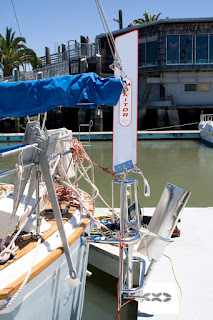 Remember that Laelia is a ketch. She has two masts. The boom on the mizzen (the aftermost sail) sticks out over the transom a bit. I figured that ScanMar had dealt with that. Much to my dismay, the initial fitting ended up looking like the picture to the right. The mizzen boom overlapped the wind vane by a good four inches. That means that every time I tack or gybe and the mizzen boom is going to swing across the boat, I have to remove the vane, do the maneuver and reinstall the vane. Not good! With Chatelaine, the wind vane did most of the steering during these maneuvers leaving me free to deal with the sails.
I talked to the folks at Scanmar and after some discussion, they agreed to make a custom mount that would put the wind vane an additional six inches away from the boat. This meant adding two more stainless steel tubes for extra bracing. They did this at no additional cost to me. I call that great service!
 It took a while to get it all mounted. I spent the biggest part of the time drilling holes in the stainless steel tubing. One of the holes took over two hours! Fortunately, I work with people who deal with fabricating complicated devices out of exotic materials. One of them spelled out a better way to go about the drilling and it went much faster after that point. The final mounting left about two inches between the mizzen boom and the wind vane. The finished mounting job is shown to the left.
That left me with the task of attaching the lines from the servo oar to the steering wheel and running a line used to turn the vane to point the right direction. All it took was another $350 to buy additional blocks (pulleys) to route them properly and keep the friction in the lines to a minimum.
Sunday, July 29th was the day of the first sailing trial. My neighbors, Eric and Diane, were eager to go along and see how an experienced sailor handled a boat. (They were talking about me!) They live on a boat just a few feet away from mine so they had been spectators to the whole ordeal of mounting the vane. They would come to look at it, shake their head and say that it was hard to believe that it would work.
The day looked perfect from my berth at Pete's Harbor. Lots of sun, enough wind to ensure a good sail and tides that would work in my favor for the sail. When I say "would work in my favor" I mean that we set out a low tide. If I run aground at low tide, the rising tide will eventually float the boat again. If I run aground at high tide, I could be there for 12 hours and 45 minutes until the next high tide. If the next high tide wasn't as high as the previous one, it would be another 12 hours and 45 minutes before the next. This could go on for quite a long time until either I get a higher high tide or I pay someone to come drag me off the mud.
We left the slip with minimal fuss - quite a feat (if I do say so myself) given that this is undoubtedly the worst berth in the marina for getting in and out. We motored down Redwood Creek toward South San Francisco Bay and discovered that the wind was going to be from dead ahead as we went up the channel to the bay. Not to worry. The engine was running fine and we plugged along until we finally cleared the narrow channel leading to Redwood Creek.
Now, readers of this blog may recall my experience of moving the boat down here from Sausalito (see "A wild ride"). It doesn't take much wind to kick up a nasty short, steep chop in the shallow waters in the south bay. On this day, with only about 10 knots of wind, it was definitely lumpy sailing.
Nonetheless, I unrolled an appropriate amount of jib for the conditions and turned the helm over to Eric while I started messing around with the wind vane. Remember what I said about lumpy conditions? In a matter of about 10 minutes, I was hanging over the rail feeding my last ten meals to the fish. I would have one of those gut wrenching episode, do some work with the wind vane and return to feeding the fish.
The result? When Laelia was going to windward, the wind vane did an excellent job of steering. But then again, Laelia will sail herself for short periods when going to windward so that wasn't much of a test.
By the time we had tried this out, I had my third trip to the rail and I was ready to call it quits for the day. We turned downwind to return to Pete's Harbor. The vane didn't do quite so good a job downwind. Laelia was out of trim (my fault) and she tends to wallow in a following sea to begin with. I had to keep on the helm and add corrections to keep her on course. I thing that this was mostly because of the arrangement of the steering lines. There was too much slack in them and I had no good way of adjusting them. I was able to both tack and gybe with the wind vane doing most of the steering and the mizzen boom did not hit the wind vane.
Sad to say, I was paying too much attention to the wind vane and not enough to navigating. At some point, Diane pointed to a channel marker some way off to starboard and asked if that was the one we were suppose do be sailing to. I pulled out the GPS unit and saw that she was correct. It was actually the second marker - we had missed the entrance to the channel Redwood Creek channel and were sailing merrily along toward the main channel toward the Dumbarton Bridge. In my debilitated condition, I made a bad decision. I decided to cut across from the channel we were in to the one we wanted to be in. It was just past low tide so it is no surprise that in short order we were stuck in the mud.
I figured that the rising tide and the action of the waves lifting the boat would eventually get us off the bottom. I was right, but it took a little over two hours. In the meantime, we were getting beaten up by the choppy waves. We were turned beam on (sideways) to the waves. They would break against the side of the boat and the spray would douse us all. Fortunately, I had put on my foul weather pants earlier so I wasn't in too bad shape. Eric and Diane didn't have foul weather gear but they took it all in stride. They sat out in the cockpit with me for a while getting doused by breaking waves and even went up on the bow for a bit to see if the weight shift would float us off. It didn't. I suggested that they should go below where it was warmer and drier. Eventually they did and passed up the jacket to my foul weather gear so I was pretty well protected. It was just a matter of waiting it out until we floated free.
At long last, we floated/motored free into the Redwood Creek channel and headed home. The rest of the trip was fairly uneventful except that with the wind and the tidal current, I managed to scape the piling on one side of my slip. I scraped it hard enough to remove several feet of varnish from the cap rail (the wooden trim rail around the edge of the deck.)
I think that there's nothing wrong with the wind vane that another hundred or so dollars worth of parts won't cure. Everyone who has ever owned a boat is aware of the saying that a boat is just a hole in the water that the owner tries to fill up by throwing in money. I have some of the parts on order and I look forward to getting it all rigged and trying it again.
It will be a blessing if the next time out does not include seasickness and getting stuck in the mud!
The solution to this is either an autopilot or a wind vane. Autopilots require a lot of electrical power when they are in continuous operation - especially when I'm sailing down wind. I hope to do a lot of down wind sailing. It is so much more pleasant than beating into the wind and the waves.
A wind vane is a logical choice for a sailboat. It uses wind power and water power to do the steering. It consists of a vane that senses wind direction and some kind of linkage to a rudder to make corrections so the boat stays at the same angle to the wind. Since sailboats are wind powered, this makes a lot of sense. Yes, when the wind shifts, so does the boat's course. That's when I get up out of my bunk, reset the vane and retrim the sails. With an autopilot, the course would stay the same but I still would have to do the sail trimming. All told, I would say the wind vane is the hands down winner in the autopilot/wind vane competition on a sailboat.
One of the really great things about a wind vane is that it is a silent crew member. It doesn't complain. It doesn't eat. I doesn't get tired of steering the boat. What more could I ask for? Well ... we won't go into that here.
Way back in the dark ages - about 1960 or so, an Englishman by the name of Blondie Hasler came up with an arrangement called a pendulum-servo wind vane. It consists of a vane that sticks up into the air and can be turned to the desired angle between the boat and the wind. If the boat goes a bit off course, the vane is blown over to one side. The vane is linked to a rudder-like device (an oar) in the water that, in addition to being able to turn, it swings from side to side like a pendulum. When the oar turns, the pressure of the water flowing past it causes the oar to swing to one side. There are lines (ropes) attached to the oar that, in turn, are attached to the tiller or steering wheel in a way that causes the boat to return to the original angle relative to the wind.
I'm sure that is confusing. Maybe it will be more clear as this discourse progresses.
When I sailed my old boat, Chatelaine, out into the Pacific in 1975/76, I had an early model of the wind vane now known as the Monitor. At the time, it was considerably cheaper than the Aries, the only other pendulum-servo wind vane on the market. When I started thinking about a wind vane for Laelia, I was delighted to find that the Monitor had become easily the most popular pendulum-servo wind vane on the market. I visited the manufacturing facility at Scanmar International in Richmond, CA, and found that my beloved Monitor has been much improved over the years. It is built of better quality, more robust materials than my old vane. Additionally, the Monitor has been installed on a number of boats identical to mine so ScanMar had detailed drawings of the installation.
I finally scraped together the money to buy the Monitor about a month ago. It looked to be a pretty simple proposition to mount it on the transom (the rear-most part of the boat). There were four mounting brackets and four stainless steel tubes that positioned the wind vane. I went to work installing the upper brackets and did a trial fitting to see how it would all work.

I talked to the folks at Scanmar and after some discussion, they agreed to make a custom mount that would put the wind vane an additional six inches away from the boat. This meant adding two more stainless steel tubes for extra bracing. They did this at no additional cost to me. I call that great service!

That left me with the task of attaching the lines from the servo oar to the steering wheel and running a line used to turn the vane to point the right direction. All it took was another $350 to buy additional blocks (pulleys) to route them properly and keep the friction in the lines to a minimum.
Sunday, July 29th was the day of the first sailing trial. My neighbors, Eric and Diane, were eager to go along and see how an experienced sailor handled a boat. (They were talking about me!) They live on a boat just a few feet away from mine so they had been spectators to the whole ordeal of mounting the vane. They would come to look at it, shake their head and say that it was hard to believe that it would work.
The day looked perfect from my berth at Pete's Harbor. Lots of sun, enough wind to ensure a good sail and tides that would work in my favor for the sail. When I say "would work in my favor" I mean that we set out a low tide. If I run aground at low tide, the rising tide will eventually float the boat again. If I run aground at high tide, I could be there for 12 hours and 45 minutes until the next high tide. If the next high tide wasn't as high as the previous one, it would be another 12 hours and 45 minutes before the next. This could go on for quite a long time until either I get a higher high tide or I pay someone to come drag me off the mud.
We left the slip with minimal fuss - quite a feat (if I do say so myself) given that this is undoubtedly the worst berth in the marina for getting in and out. We motored down Redwood Creek toward South San Francisco Bay and discovered that the wind was going to be from dead ahead as we went up the channel to the bay. Not to worry. The engine was running fine and we plugged along until we finally cleared the narrow channel leading to Redwood Creek.
Now, readers of this blog may recall my experience of moving the boat down here from Sausalito (see "A wild ride"). It doesn't take much wind to kick up a nasty short, steep chop in the shallow waters in the south bay. On this day, with only about 10 knots of wind, it was definitely lumpy sailing.
Nonetheless, I unrolled an appropriate amount of jib for the conditions and turned the helm over to Eric while I started messing around with the wind vane. Remember what I said about lumpy conditions? In a matter of about 10 minutes, I was hanging over the rail feeding my last ten meals to the fish. I would have one of those gut wrenching episode, do some work with the wind vane and return to feeding the fish.
The result? When Laelia was going to windward, the wind vane did an excellent job of steering. But then again, Laelia will sail herself for short periods when going to windward so that wasn't much of a test.
By the time we had tried this out, I had my third trip to the rail and I was ready to call it quits for the day. We turned downwind to return to Pete's Harbor. The vane didn't do quite so good a job downwind. Laelia was out of trim (my fault) and she tends to wallow in a following sea to begin with. I had to keep on the helm and add corrections to keep her on course. I thing that this was mostly because of the arrangement of the steering lines. There was too much slack in them and I had no good way of adjusting them. I was able to both tack and gybe with the wind vane doing most of the steering and the mizzen boom did not hit the wind vane.
Sad to say, I was paying too much attention to the wind vane and not enough to navigating. At some point, Diane pointed to a channel marker some way off to starboard and asked if that was the one we were suppose do be sailing to. I pulled out the GPS unit and saw that she was correct. It was actually the second marker - we had missed the entrance to the channel Redwood Creek channel and were sailing merrily along toward the main channel toward the Dumbarton Bridge. In my debilitated condition, I made a bad decision. I decided to cut across from the channel we were in to the one we wanted to be in. It was just past low tide so it is no surprise that in short order we were stuck in the mud.
I figured that the rising tide and the action of the waves lifting the boat would eventually get us off the bottom. I was right, but it took a little over two hours. In the meantime, we were getting beaten up by the choppy waves. We were turned beam on (sideways) to the waves. They would break against the side of the boat and the spray would douse us all. Fortunately, I had put on my foul weather pants earlier so I wasn't in too bad shape. Eric and Diane didn't have foul weather gear but they took it all in stride. They sat out in the cockpit with me for a while getting doused by breaking waves and even went up on the bow for a bit to see if the weight shift would float us off. It didn't. I suggested that they should go below where it was warmer and drier. Eventually they did and passed up the jacket to my foul weather gear so I was pretty well protected. It was just a matter of waiting it out until we floated free.
At long last, we floated/motored free into the Redwood Creek channel and headed home. The rest of the trip was fairly uneventful except that with the wind and the tidal current, I managed to scape the piling on one side of my slip. I scraped it hard enough to remove several feet of varnish from the cap rail (the wooden trim rail around the edge of the deck.)
I think that there's nothing wrong with the wind vane that another hundred or so dollars worth of parts won't cure. Everyone who has ever owned a boat is aware of the saying that a boat is just a hole in the water that the owner tries to fill up by throwing in money. I have some of the parts on order and I look forward to getting it all rigged and trying it again.
It will be a blessing if the next time out does not include seasickness and getting stuck in the mud!
Thursday, July 19, 2012
Now I'm cooking with gas!
Back in the days of my youth, we lived in caves and cooked over campfires using wood as fuel. It worked but it was awfully slow when we were standing around with an appetite and waiting for a slab of woolly mammoth to be reheated to body temperature. One evening, our cooking session was interrupted by a large dinosaur - a brontosaurus, as I remember. We dove for cover in the cave while the bronto sniffed around hoping for some form of food. Being strictly vegetarian, he/she didn't find anything of interest. Being strictly vegetarian, the critter also farted prolifically. One of these expulsions of gas came when the bronto was close to the fire. The ensuing explosion frightened the critter away.
As with many disasters, there was a lesson to be learned. Acting on a hunch, we went looking for brontosauri the next day. We carried with us some size able clay urns. The objective was to get close enough to catch an urn-full of flatulence. We were successful. The evening's cooking session went much faster as we released the urns of brontosaurus gas through large diameter bamboo tubes in the vicinity of the fire. In short order, we were eating dinner. Thus came the expression, "Now we're cooking with gas!"
 Fast forward now to life aboard Laelia. Since I moved aboard in December, I have been cooking on a single burner hotplate. You can see the hotplate in the picture to the right. I did have a section of counter top over that big hole, but you can kind of get the idea what my galley (kitchen) looked like. It works but the hotplate is sometimes maddenly slow. I timed how long it took to get a half filled pasta pot to boil - 45 minutes! Not satisfactory! I like my pasta and when I get home from work at 7:30 PM, I don't feel like waiting 45 minutes for the water to boil. What to do?
My first thought was to go back to the olden days but I quickly realized that there were no longer any dinosaurs roaming nearby. I suppose cows would be an adequate substitute but those are about as available as dinosaurs here in Silicon Valley.
While perusing a West Marine catalog, I came across a Shipmate 3 burner propane stove that looked like just the thing. It even has gimbals. Gimbals are devices to keep the stove level while the boat is rolling from side to side. I paid an outrageous amount of money to have a propane locker installed in the lazarette (a storage compartment in the very farthest aft section of the cockpit). Unfortunately, this used up all my money. I had to wait until I found a job and paid off some bills before I could actually buy the stove.
 Last weekend, I ordered the stove. On Wednesday, I got a call telling me that the stove had arrived. I left work early to pick it up and hot footed it back to Laelia to install it. Amazingly enough, it turned out to be not much of a problem. By 11 PM, I had it installed and I was boiling water in my tea kettle. See the picture to the right.
This evening, I did a comparison. I was lusting for a pot of spaghetti so I hauled out the pasta pot, filled it, turned on the stove and started a timer. Fourteen minutes later, I had a vigorously boiling pot of water. Huzzah! I'm back to cooking with gas!
By the way, the wind vane project is moving along. I am waiting for some parts so I can finish it off. I will post pictures and commentary on the process after the first sailing trial. Stay tuned!
As with many disasters, there was a lesson to be learned. Acting on a hunch, we went looking for brontosauri the next day. We carried with us some size able clay urns. The objective was to get close enough to catch an urn-full of flatulence. We were successful. The evening's cooking session went much faster as we released the urns of brontosaurus gas through large diameter bamboo tubes in the vicinity of the fire. In short order, we were eating dinner. Thus came the expression, "Now we're cooking with gas!"

My first thought was to go back to the olden days but I quickly realized that there were no longer any dinosaurs roaming nearby. I suppose cows would be an adequate substitute but those are about as available as dinosaurs here in Silicon Valley.
While perusing a West Marine catalog, I came across a Shipmate 3 burner propane stove that looked like just the thing. It even has gimbals. Gimbals are devices to keep the stove level while the boat is rolling from side to side. I paid an outrageous amount of money to have a propane locker installed in the lazarette (a storage compartment in the very farthest aft section of the cockpit). Unfortunately, this used up all my money. I had to wait until I found a job and paid off some bills before I could actually buy the stove.

This evening, I did a comparison. I was lusting for a pot of spaghetti so I hauled out the pasta pot, filled it, turned on the stove and started a timer. Fourteen minutes later, I had a vigorously boiling pot of water. Huzzah! I'm back to cooking with gas!
By the way, the wind vane project is moving along. I am waiting for some parts so I can finish it off. I will post pictures and commentary on the process after the first sailing trial. Stay tuned!
Thursday, July 5, 2012
The Great Transmission Adventure
... in which I learn (and re-learn) lots of things.
The first effort at getting the transmission problem resolved involved a fellow occupant of the marina who claimed some expertise in engine and transmission matters. He came to the boat, looked it over and said he would pull the transmission out and take it to his shop. In an effort to save some money, I said I would pull the transmission and have it ready for him later in the week. Wrong answer! I didn't hear from him for a couple of weeks. I ran into him one day on the dock and he was not happy that I was doing the part that was going to earn him some money. I was having trouble getting the transmission out so I offered him the chance to finish the job. He declined. Oh well!
Did I mention that I was having trouble getting the transmission out of the boat? Well, I was. It all sounded so simple. 1) Disconnect the prop shaft. (That was easy). 2) Remove the four bolts that hold the transmission onto the engine. 3) Beat on it with a rubber hammer until it comes loose. This is where the fun (?) began. I beat on it periodically most of one weekend. It wouldn't budge. I periodically applied a mixture of automatic transmission fluid and acetone as a rust penetrant and beat on it some more in the evenings of the week following. Nothing moved. The next weekend I was in Placerville so nothing got done. The following week was a repeat of the previous - come home from work, brush on a little more penetrant, beat on the transmission and give up in frustration.
 Finally, the next weekend, I rigged up a block and tackle arrangement (see picture to the right) to put a healthy pull on the transmission while I beat on it and (ta-dah!) it came loose. Much to my chagrin, the place I had been applying the rust penetrant was not the place where the transmission mated to the engine.
So, OK, now I have a transmission lying in the cockpit ready to be repaired. The only problem is that I don't know who does that. I did an Internet search and didn't come up with anything that looked promising. I lefat a message for a yard foreman who didn't return my call and another one for the surveyor who did the survey on the boat when I bought it. The surveyor returned my call. I described the problem. He said he would get back to me with some information on where to go for the next step. After I had hounded him with three more calls, I gave up on him.
The next move was fairly obvious. I called around to some boat yards and asked who could look at the transmission. A place called "The Boatyard at the Grand Marina" in Alameda said they could do it. The gentleman I talked to said they were open 8 - 5 weekdays. I explained that I work 9 - 6 in Santa Clara so that was going to be a problem. After some back and forth conversation, he said that one of the mechanics usually showed up at 6 AM and I could leave it with him.
Monday morning, I was out of bed at 5:30, ate breakfast and hit the road to Alameda. For those of you who do not know the SF Bay area, there are three bridges across the bay that handle all of the traffic going from SF and the peninsula to the south to what is known as the East Bay. That means that the morning commute gets pretty ugly. Going over was not too bad. Traffic moved at the speed limit across the San Mateo bridge and then crawled up the Nimitz Freeway (aka Interstate 880). As I was approaching Alameda, the morning radio show I had tuned in announced that there had been a fire on the BART line (the commuter train that runs under the bay from East Bay to SF) and both tracks were shut down. This put a whole bunch more traffic on the road headed for the bridges. It was looking pretty grim for the trip back to Santa Clara.
I pulled into "The Boatyard at the Grand Marina" a few minutes before 7 AM. With some luck, I could make it to work pretty much on time. Unfortunately, the luck was not with me. The shop was locked up tight. I sat in my car and watched the front door waiting for someone to arrive. Finally, at 8:10, a car pulled up and a man jumped out and ran for the front door. He unlocked it and went in. I followed closely. I explained who I was and why I was there so early. He apologized profusely and explained that USUALLY someone was there early but for some reason no one was this morning. Oh well!
I explained the problem I was having with the transmission. He wrote up a repair ticket and hauled the transmission into the shop. I beat feet for my car and left in a hurry in the hpe that I wouldn't bee TOO late for work. I promptly missed the turn onto the freeway and spent 10 minutes trying to find my way back. Once on the freeway, the traffic was slow and go - remember the BART problem? By the time I got back to the San Mateo bridge, the lane for getting onto the bridge was backed up for at least two miles. I kept going South in the hope that the Dumbarton Bridge would be better. It was.
Once back across the bridge, the normal thing to do would be to get on highway 101 south. As I drove over the overpass, it looked like it was pretty badly jammed up so I decided to be clever and take some back streets to bypass the mess. Unfortunately, I don't know the back streets very well and I spent a frustrating 15 - 20 minutes finding my way to Interstate 280 where I was pretty sure there would be no traffic problem. For once, I was right. It was the ususal 75 - 80 mph all the way into Santa Clara. I was only 30 minutes late for work. Not that anyone noticed - but it did mean working late.
Two days later, I got a call from the boat yard. They had done some minor adjustments and said there was nothing wrong with the transmission. The thing that bothered me about that was that I had made the same adjustment and it hadn't made a difference. I drove over to the shop early Friday morning, talked to the mechanic who had done the work, paid $150 for the work and took the transmission back to the boat.
Saturday morning, I put the transmission back in place. It still did not work. I pulled the transmission back out (it was easier this time) and looked at the place where the transmission shaft went into the engine. It is an gizmo called the damper plate. I removed the damper plate and looked at it carefully. Aha! The center of the damper plate has a hole with splines (little ridges and grooves) that are suppose to match up with the transmission shaft. (See picture to the right.) Most of the splines were stripped. The engine would run merrily along turning the damper plate - but with no splines, the damper plate spun freely around the transmission shaft. (The transmission shaft is the next picture - below to the right.)
Another Internet search turned up a dealer for the engine. He was in Fairfield - a good hour and a half drive from here. I called and found out that the replacement damper plate would cost $225 and they could UPS it to me. The problem with that is that I didn't have a local mailing address. I had them send it to Placerville and picked it up the next weekend on my regular trip home.
It took a couple of evenings in the following week to install the damper plate, reinstall the transmission and verify that it appeared to fix the problem. Encourage at this, I hooked up the propeller shaft, started up the engine and put it in gear. Voila! Laelia moved forward against her dock lines. I put the transmission in reverse and she backed up! It looks like we have a fix! The one remaining concern is that the transmission shaft splines look kind of beat up and it looks like the shaft does not go all of the way into the damper plate. It felt like it was a nice snug fit when I did a trial fit on the transmission shaft before installing the plate on the engine. I wonder when (or if) it will fail the same way.
Later that weekend, I backed Laelia out of the slip, turned her around and backed her into the slip (with a little help from my friends) in preparation for the next big adventure - installing the wind steering vane.
So! What did I learn from all of this? The biggest thing was that I need to look into these repairs and upgrades myself before I call in the paid help. Most of it is not rocket science and there are plenty of knowledgeable people on the Internet willing to give advice. Of course, one has to do some sanity checking on the advice, but I did get some good help this way. I need to know how to do a lot of this stuff if I am going to sail off to places where it is hard to find help.
The other thing I learned yet again is that a lot of people are not too good on follow-through when they say they will help. Best to do it myself, if possible.
Stay tuned for updates on installing the wind vane. It is a beautiful, ingenious piece of hardware that will steer the boat for me using only the wind and water to power it. It is a major "must-have" item for sailing alone. It is a big milestone in getting ready to go.
The first effort at getting the transmission problem resolved involved a fellow occupant of the marina who claimed some expertise in engine and transmission matters. He came to the boat, looked it over and said he would pull the transmission out and take it to his shop. In an effort to save some money, I said I would pull the transmission and have it ready for him later in the week. Wrong answer! I didn't hear from him for a couple of weeks. I ran into him one day on the dock and he was not happy that I was doing the part that was going to earn him some money. I was having trouble getting the transmission out so I offered him the chance to finish the job. He declined. Oh well!
Did I mention that I was having trouble getting the transmission out of the boat? Well, I was. It all sounded so simple. 1) Disconnect the prop shaft. (That was easy). 2) Remove the four bolts that hold the transmission onto the engine. 3) Beat on it with a rubber hammer until it comes loose. This is where the fun (?) began. I beat on it periodically most of one weekend. It wouldn't budge. I periodically applied a mixture of automatic transmission fluid and acetone as a rust penetrant and beat on it some more in the evenings of the week following. Nothing moved. The next weekend I was in Placerville so nothing got done. The following week was a repeat of the previous - come home from work, brush on a little more penetrant, beat on the transmission and give up in frustration.

So, OK, now I have a transmission lying in the cockpit ready to be repaired. The only problem is that I don't know who does that. I did an Internet search and didn't come up with anything that looked promising. I lefat a message for a yard foreman who didn't return my call and another one for the surveyor who did the survey on the boat when I bought it. The surveyor returned my call. I described the problem. He said he would get back to me with some information on where to go for the next step. After I had hounded him with three more calls, I gave up on him.
The next move was fairly obvious. I called around to some boat yards and asked who could look at the transmission. A place called "The Boatyard at the Grand Marina" in Alameda said they could do it. The gentleman I talked to said they were open 8 - 5 weekdays. I explained that I work 9 - 6 in Santa Clara so that was going to be a problem. After some back and forth conversation, he said that one of the mechanics usually showed up at 6 AM and I could leave it with him.
Monday morning, I was out of bed at 5:30, ate breakfast and hit the road to Alameda. For those of you who do not know the SF Bay area, there are three bridges across the bay that handle all of the traffic going from SF and the peninsula to the south to what is known as the East Bay. That means that the morning commute gets pretty ugly. Going over was not too bad. Traffic moved at the speed limit across the San Mateo bridge and then crawled up the Nimitz Freeway (aka Interstate 880). As I was approaching Alameda, the morning radio show I had tuned in announced that there had been a fire on the BART line (the commuter train that runs under the bay from East Bay to SF) and both tracks were shut down. This put a whole bunch more traffic on the road headed for the bridges. It was looking pretty grim for the trip back to Santa Clara.
I pulled into "The Boatyard at the Grand Marina" a few minutes before 7 AM. With some luck, I could make it to work pretty much on time. Unfortunately, the luck was not with me. The shop was locked up tight. I sat in my car and watched the front door waiting for someone to arrive. Finally, at 8:10, a car pulled up and a man jumped out and ran for the front door. He unlocked it and went in. I followed closely. I explained who I was and why I was there so early. He apologized profusely and explained that USUALLY someone was there early but for some reason no one was this morning. Oh well!
I explained the problem I was having with the transmission. He wrote up a repair ticket and hauled the transmission into the shop. I beat feet for my car and left in a hurry in the hpe that I wouldn't bee TOO late for work. I promptly missed the turn onto the freeway and spent 10 minutes trying to find my way back. Once on the freeway, the traffic was slow and go - remember the BART problem? By the time I got back to the San Mateo bridge, the lane for getting onto the bridge was backed up for at least two miles. I kept going South in the hope that the Dumbarton Bridge would be better. It was.
Once back across the bridge, the normal thing to do would be to get on highway 101 south. As I drove over the overpass, it looked like it was pretty badly jammed up so I decided to be clever and take some back streets to bypass the mess. Unfortunately, I don't know the back streets very well and I spent a frustrating 15 - 20 minutes finding my way to Interstate 280 where I was pretty sure there would be no traffic problem. For once, I was right. It was the ususal 75 - 80 mph all the way into Santa Clara. I was only 30 minutes late for work. Not that anyone noticed - but it did mean working late.
Two days later, I got a call from the boat yard. They had done some minor adjustments and said there was nothing wrong with the transmission. The thing that bothered me about that was that I had made the same adjustment and it hadn't made a difference. I drove over to the shop early Friday morning, talked to the mechanic who had done the work, paid $150 for the work and took the transmission back to the boat.
 |
| Damper plate - most of the splines are gone! |
 |
| Transmission shaft - splines on the left. |
Saturday morning, I put the transmission back in place. It still did not work. I pulled the transmission back out (it was easier this time) and looked at the place where the transmission shaft went into the engine. It is an gizmo called the damper plate. I removed the damper plate and looked at it carefully. Aha! The center of the damper plate has a hole with splines (little ridges and grooves) that are suppose to match up with the transmission shaft. (See picture to the right.) Most of the splines were stripped. The engine would run merrily along turning the damper plate - but with no splines, the damper plate spun freely around the transmission shaft. (The transmission shaft is the next picture - below to the right.)
Another Internet search turned up a dealer for the engine. He was in Fairfield - a good hour and a half drive from here. I called and found out that the replacement damper plate would cost $225 and they could UPS it to me. The problem with that is that I didn't have a local mailing address. I had them send it to Placerville and picked it up the next weekend on my regular trip home.
It took a couple of evenings in the following week to install the damper plate, reinstall the transmission and verify that it appeared to fix the problem. Encourage at this, I hooked up the propeller shaft, started up the engine and put it in gear. Voila! Laelia moved forward against her dock lines. I put the transmission in reverse and she backed up! It looks like we have a fix! The one remaining concern is that the transmission shaft splines look kind of beat up and it looks like the shaft does not go all of the way into the damper plate. It felt like it was a nice snug fit when I did a trial fit on the transmission shaft before installing the plate on the engine. I wonder when (or if) it will fail the same way.
Later that weekend, I backed Laelia out of the slip, turned her around and backed her into the slip (with a little help from my friends) in preparation for the next big adventure - installing the wind steering vane.
So! What did I learn from all of this? The biggest thing was that I need to look into these repairs and upgrades myself before I call in the paid help. Most of it is not rocket science and there are plenty of knowledgeable people on the Internet willing to give advice. Of course, one has to do some sanity checking on the advice, but I did get some good help this way. I need to know how to do a lot of this stuff if I am going to sail off to places where it is hard to find help.
The other thing I learned yet again is that a lot of people are not too good on follow-through when they say they will help. Best to do it myself, if possible.
Stay tuned for updates on installing the wind vane. It is a beautiful, ingenious piece of hardware that will steer the boat for me using only the wind and water to power it. It is a major "must-have" item for sailing alone. It is a big milestone in getting ready to go.
Subscribe to:
Posts (Atom)