The plan for today, Saturday, March 18, 2012, was to move the boat about 30 miles from Sausalito to Pete's Harbor in Redwood City - weather permitting. I was feeling some pressure to make it happen on schedule since I hoped to start work on Monday. The thought of commuting from Sausalito to Santa Clara 55 miles one way plus a $6 bridge toll each day was not particularly appealing.
Yesterday, it blew and it rained. Fortunately, it didn't keep Ben from Hirshfield Yachts from coming out and doing the annual maintenance on the engine. I don't think it has been done since sometime in 2008. I didn't relish the thought of taking off on what could be eight hours of motoring without the maintenance.
When I went to sleep last night, it was still blowing hard with gusts up to 25 knots. The boat was rocking and rolling me to sleep. Sometime during the night, I woke up and realized that it was dead calm. The marine weather forcast had been calling for winds of 5 to 15 knots with a chance of showers and a thunderstorm. By this morning the chance of showers had dropped to about 30% with a slight chance of thunderstorms.
When I woke up, I stuck my head out the hatch expecting to see fog. There was none. It was mostly overcast with a patch of sun to the south. The move was on!
I made breakfast, finished putting things away and pulled out of the slip by a little after 10 AM. I made a brief stop at the fuel dock to pump out the holding tank and the trip began.
There was so little wind that I fully expected to have to motor the whole trip. I did hoist the main to keep Laelia from rolling so badly in the wake of the ferries and tour boats. I got a closer look at the a tour boat called Golden Bear than I wanted. When I first spotted her coming from behind Angel Island, I thought she was a Coast Guard cutter headed out the Golden Gate. Her course would take her well astern of me. When she got closer, she started to turn toward the SF waterfront putting her on a collision course. I had the right of way but she didn't appear to have any intention of altering course. I didn't feel like playing chicken so I changed course to pass behind her.
This was my first trip out using a GPS unit on the boat. It is a hand-held Garmin GPSmap 76Cx. I had plotted out the trip on OpenCPN - a marine mapping program - and transferred my waypoints to the hand-held unit. The GPS unit does nice things like tell me how fast I am moving over the bottom, how long it will take me to reach my next waypoint, how long until I reach my destination, etc.
The first part of the trip took be past Alcatraz once again. The boat speedometer told me I was making 4.5 knots through the water but the GPS said I was making 2 knots over the bottom. That was expected - the tide was going out.
Conditions stayed pretty much the same for the first three hours as I passed Alcatraz, passed the SF waterfront and went under the Bay Bridge. Shortly after I passed the Bay Bridge a bit of breeze came up. I unfurled the jib and got a little boost from the wind. With the help, Laelia was cruising along at almost 5 knots.
Then the wind started to pick up. I shut down the engine and hoisted the mizzen. The wind was a good one for a ketch - a broad reach with the wind coming from a little abaft the beam (a little behind straight from the side.) In short order, Laelia was up to 5 knots again without the noise of the engine. Then she was going 5.5 and then 6 knots. Great sailing! According to the anemometer, the wind was around 10 knots with gusts to 15 - for a while.
Gradually, the wind picked up. In the relatively shallow bay waters, the waves build up quickly so it was not long before Laelia was starting to roll and yaw (turn from side to side) enough to make it a lot of work to keep her on course.
I dropped the mizzen - no small job under those conditions. Every time I would let go of the wheel to do some work, Laelia would try to turn to starboard into the wind. That got the sails to flogging (flapping) pretty hard. That's not particularly good. It accelerates sail wear and can cause some of the stitching to come apart. Nevertheless, I did get the mizzen down. It was a pretty sloppy job. Instead of being neatly rolled up and tied to the mizzen boom, the sail was mostly wadded up into a ball and tied. By the time this was done, I was starting to feel a touch of motion sickness.
Dropping the mizzen dropped the speed to about 5.5 knots with excursions to over 6 knots. Laelia was still rolling and yawing uncomfortably. I rolled up the jib a bit - maybe a quarter of the way. The wind was now a pretty steady 15 knots and clearly I was carrying too much sail. The remedy was to heave to (tack without letting the jib come across to the other side.) That pretty much killed the boat speed. Laelia was lying sideways to the waves and rolling heavily. It wasn't bad enough to be dangerous but it didn't do anything to help my already unsettled stomach.
I got the main down with some difficulty. By the time I got the sail down, I was feeling seasick. I made a dash for the wheel and got Laelia headed downwind again. Being at the wheel seemed to help my stomach feel better.
But lo and behold, when I looked up at the main, things were not as they should be. The main has several battens (plastic rods that lie parallel to the foot of the sail) sewn into pockets in the sail. I have never liked battens. They are supposed to help the main hold its shape in light air. What they seem to do is get caught in different parts of the rigging at the most inopportune times. That's what happened now. Instead of the sail falling down neatly between the lazy jacks (sort of a rope cradle to contain the sail when it is dropped) one of the battens got caught in the lee (downwind) lazy jack and was holding part of the sail cocked skyward instead of lying along the main boom as it should. I could only hope that the wind wouldn't catch it and pull the rest of the sail out of its resting place as well.
Laelia was still moving along at better than 5 knots with only the jib. I checked the GPS and discovered that if we kept moving at this pace, we would get to Pete's Harbor at almost dead low tide. That could be a problem since the Redwood Creek channel is fairly shallow at points. I needed to slow down.
I decided to roll up still more of the jib. Now, the people who love roller jibs say that they are wonderful because all you have to do is roll it up and it gets smaller. Before roller jibs, I had to drop the jib, unhook it from the forestay, bag it and stow the bag. Then I would pull out the replacement jib, hook it on the forestay, tie on the jib sheets and hoist the new sail. That sounds like a lot of work, but the mechanics of it are pretty simple and there isn't much that can go wrong with it.
I discovered that trying to roll up a jib under pressure is not a trivial task as its proponents would have us believe. I put the furling line on a winch and started cranking. It didn't appear to be working. I let Laelia turn until the jib started to flog and I cranked. That worked a little better. I got the sail area reduced to about 1/2 the amount of the full sail but the flogging makes a horrible noise and I wondered just how much of that the sail could take.
I got Laelia headed downwind again and she was still clipping along at 4 knots. Then, I noticed that there was a problem with the jib sheets. With all the flogging, the weather sheet (the one that wasn't doing any work) had pulled it self all of the way out of all its blocks (pulleys) and wrapped itself around the lee sheet (the one doing all the work.) My bad! I should have had a stopper knot (a knot in the end of the sheet) to keep the sheet from coming loose. It wasn't an immediate problem, but if I had to gybe (turn so the wind is coming over the other rail) it would be a problem. I wasn't eager to try to fix the problem. Laelia was still trying to broach (turn sideways to the wind and waves) every time I stopped paying close attention to the steering and my stomach was telling me that if I had to leave the wheel and do much work, I would be feeding my breakfast to the fish.
By now, we were down to the San Mateo bridge. I was hanging on hoping that as we got closer to Redwood Creek, we would be in more protected waters and I would be able to work on the problem in conditions where Laelia would be better behaved and my stomach would not be so queasy.
The wind continued to increase. I managed to roll up some more of the jib. Now we were down to about 1/4 of the full size jib and still doing 3.5 to 4 knots. The wind was blowing 20 to 25 knots and the waves were 2 - 3 feet. The fronts were steep, not nice big rounded swells like I would see on the open ocean.
As we got closer to Redwood Creek entrance, our course gradually curved toward southwest. Our course was taking us closer to shore so the waves did not have room to build up. Before long, the waves were pretty much gone and Laelia would steer herself long enough for me to fix some of the problems. I got the main straightened out a bit and got a sail tie wrapped around it and tied down the the main boom. I was able to unravel the stray sheet from the working sheet and get it run back through its blocks. I promptly gave it the stopper knot that I should have done long before.
The GPS was a major help here. I could see channel markers but the GPS gave me added confidence that I wasn't off on the wrong channel. It also helped me figure out just where Pete's Harbor was. Things look different from out on the water than they do when I'm standing on shore.
As I was getting close to Pete's Harbor, I started the engine and tried to roll up the remainder of the jib. I wouldn't quite do it. There was still a small corner of the jib peeking out. It wasn't enough to be a big problem, but I couldn't figure out why it was happening.
Even with the help of the GPS, I managed to go in the wrong entrance at Pete's Harbor and had to turn around in a very cramped space with the wind still blowing 15 knots in gusts.
When I did find the right entrance, it took some fancy maneuvering to get into my slip. I guess it looked like I was having a problem (I was). A man came out and hollered at me to ask if I needed help. I said I did and asked if he could take a line when I got into the slip. He had to go a ways to walk the docks to get to my slip and I had Laelia in the slip quickly enough that he turned around and went away.
What a relief to be in the slip! The wind kept howling as I straightened out the sails and did all the post-sail cleanup. If anything, the wind got worse. In what was perhaps a feeble attempt to make amends, Mother Nature put on a nice sunset. Too little, too late!
A close examination of the roller furling jib revealed that the jib had stretched enough that there wasn't enough furling line available to finish the job. Whoda thunk it.
I called Judy to let her know I had made it OK, ate the sandwiches I had intended to eat during the trip and went to bed. After a couple of hours, I woke up and couldn't get back to sleep so I got up and wrote all this.
Things I learned today: The big one was that I won't be singlehanding a trip like this again until I have a wind vane to help with the steering. Things were on the edge of getting really ugly today because I couldn't get away from the wheel long enough to fix problems. Also, I was reminded that I have a way to go before I get my sea legs back. I don't like being seasick, but I can deal with it if the boat can mind herself while I lean over the rail and call out my name to the fishies. And finally, I like roller furling jibs even less that I used to. I hope to replace it before I head offshore.
All is well that ends well. I got here. Nothing broke. I didn't run aground or run into any other boats. That makes it a successful trip in my book - but it was a wild ride!
And by the way, I found out I'm not starting work Monday. Maybe Tuesday. Maybe Wednesday. The background checks are not finished. The good news is that Judy and I can have some more time together when she gets here tomorrow and we won't have to drive up to Sausalito to rescue my car until Monday.
In the Fall of 1977, I discovered Silicon Valley. It was quite by accident. I really wanted to go back to San Diego but in those days there was very little work there for computer geeks. A friend recommended that I look for work in the rapidly developing San Jose/Santa Clara area coming to be known as Silicon Valley.
In short order, I found a job there at Four Phase Systems and proceeded to work toward The Dream. Simply put, it was to earn enough money to build a boat and go back to cruising as soon as possible. For about three years, I kept pretty much on focus. But then I started getting distracted by the "Money, Sex and Power" ethos that is so pervasive in Silicon Valley. In the end, my loss of focus cost me my marriage and my dream. I sold the steel I had bought for the boat at scrap prices. I spent much of my savings on learning to fly.
Eventually, I remarried and moved to Phoenix - a long way from the ocean. I was blessed with two more wonderful daughters and 21 mostly wonderful years of marriage. During those years, The Dream would resurface and I would try to stuff it back into the dark corners of my mind where it wouldn't bother me.
It worked - until I retired and started to wonder what to do with the rest of my life. (See the first entry in this blog for the gory details.) I have bought Laelia with the intention of fulling The Dream in some measure. I miscalculated - I bought more boat than I needed and it needed more work than I expected. I decided to come out of retirement for a year to pay for The Dream.
The good news is that I now have a job. The bad news is that it is in Santa Clara - in the belly of the beast, as I have come to think of it. It is stomach wrenching to be surrounded by ambitious, young hustlers, immaculately groomed, wearing ties and driving BMWs. It brings back old memories and fears. Once upon a time, I stuck my hand into the fire and got burned. Now I am reluctant to come close to anything that looks like that fire.
I believe that age and experience has brought me to the point that I will not be so easily distracted. Living on the boat helps keep me focused from one day to the next. Having a deadline of April 2013 to be heading south also keeps the pressure on. The deadline is pretty much non-negotiable. The hurricane season on the west coast of Mexico starts in June and I need to allow time for stops in San Diego and, possibly, Cabo as part of my shakedown.
It also helps that Judy is eager for me to get started. The sooner I start, the sooner I get back and we can, perhaps, resume our life together. From time to time she asks me how something I am considering will contribute to getting on with The Dream and I realize I am getting a bit off-track.
Additional bad news about the new job is that it is about 1.5 hours (55 miles) from my current location in Sausalito. With $6/day bridge toll at the Golden Gate Bridge and gas prices edging up toward the $5/gallon level, I figure it would cost about $500/month to commute from Sausalito. That's not acceptable. Saturday, if the weather permits, I will be giving up my slip in beautiful Sausalito and moving the boat south to Pete's Harbor on Redwood Creek in Redwood City.
Pete's Harbor is much smaller than Clipper Yacht Harbor and has "personality" - albeit a bit on the funky side. Also, it is located in the tidal flats. I have to pay close attention to the tides when I come and go. At low tide, the channel is quite shallow in places. Getting stuck on a falling tide would mean a long wait until the tide comes back in to float me free. Once out into the bay, there's not a lot of room to go sailing. Much of the south bay is quite shallow so I'm pretty much restricted to the channel that runs from SF to Alviso and it is getting pretty narrow by the time it gets to Redwood Creek.
The trip south will give me a chance to try out this newfangled GPS stuff. It didn't exist when I owned my first boat. Navigation was a combination of dead reckoning and celestial navigation. Now I hear that some foolhardy souls actually go to sea without learning celestial navigation and rely totally on GPS. It seems scary to me. Electronics and seawater are not a good combination! Nonetheless, I have bought a handheld GPS complete with marine navigational charts. I used a freeware program called OpenCPN to plot the course for my trip to Pete's Harbor and download the route and waypoints into the handheld unit. I am also laying out the trip on paper charts in the traditional manner - just in case.
So - back into the belly of the beast but with a difference. Forewarned is forearmed. Experience is the best teacher, etc, etc, blah, blah.
 The stars have finally aligned for Judy to come to the boat and go sailing. The weather was forecast to be sunny and warm with light and variable winds. What more could we ask for?
 We got to the boat yesterday evening after an enjoyable dinner with daughter Suzanne in Davis. This morning, I had a bit of work to do. The longitudinal bulkheads in the starboard cockpit locker were made of rotting pegboard and I had to replace them or run the risk of a bunch of tools and other junk falling into the engine compartment when the boat heels. I had made up a replacement while I was at home in Placerville last weekend.
While I was doing this, Judy took advantage of being away from home, the beautiful weather and the absence of other responsibilities. She was (gasp) reading a book in the daytime! Normally, her work ethic will not allow her to take time to read until she is in bed in the evening.
It took about an hour to install the new panels. Then it was time to put everything away and prepare to sail!
As we headed out the channel toward the bay, the wind was from dead ahead - of course. That meant we motored until we were well clear of the Spinnaker Restaurant. That it gave Judy a chance to learn to steer the boat under the easiest conditions. No problem - she's a natural! It was great to have her steer while I put up sails. It saved me racing back and forth between the wheel and the sails.
When we picked up some wind, I shut off the motor and we were under sail - a completely new experience for Judy. I am happy to say that she was practically jumping with delight!
We were on the wind making about 5 knots and pointed right at Alcatraz at first but as we got farther out into the bay, the wind direction shifted until we were running almost dead down wind to stay pointed at Alcatraz. Judy was steering off and on as I played with sails so she got to see how sail trim affects the steering. Laelia is a joy to sail when we are on the wind but not so much when the wind goes abaft the beam (i.e., it is coming from someplace between straight from the side and directly behind the boat.)

I had picked sailing toward Alcatraz again because we set sail just after high tide. That meant that the currents would be flowing out the Golden Gate and it might be hard to get back if we went out under the bridge and the wind dropped. It turned out to be a good decision. As we got close to Alcatraz, the wind dropped until we were doing 1.5 to 2 knots. The outgoing tide kept us from making enough progress to round Alcatraz. After about half an hour of dealing with shifty winds and getting nowhere, we gave up and headed back toward Sausalito. As soon as we did that, the wind picked up again and we were moving along at a comfortable 5.5 knots - for a while. Then the wind dropped again and our speed gradually fell off until we decided to crank up the engine and start motoring again.
We hadn't been motoring long before I looked astern and noticed that there was a line across our wake behind us. On our side of the line, the water was fairly smooth. On the other side, it was very choppy. The choppy water quickly overtook us and began pushing the boat toward the Marin shoreline. We had witnessed the birth of a rip current caused by the outgoing tide. It made me grateful we weren't engineless like the sailors of old. We might well have been pushed onto the rocks at Pt Cavallo.
We were back into the slip at 4:30 - just in time for a very pleasant happy hour. We drank wine and enjoyed a snack as the sun set behind the hills to the west.
Judy says she really enjoyed the sail and is looking forward to more. Now if I can just persuade her to sail to Tahiti with me...
When wind and tide cooperate, getting to Alcatraz is a breeze (pun intended - of course).
 Today was a mixture of sun and clouds and (happily) some wind as the afternoon wore on. I started out wanting to try sailing Laelia with the main being the only sail hoisted. It is convenient sometimes to be able to tack back and forth without having to take care of the jib every time I tack. Laelia does not do this well. In a 10 knot breeze she gets up enough speed to do it - but she does it reluctantly. When the wind dropped, she wouldn't do it at all.
The wind picked up as I got out toward the slot - blowing 10 to 15 knots straight in from the Golden Gate bridge. To top it off, the tide was coming in and would be pushing me toward Alcatraz. Perfect!
 I unfurled about half of the jib and set off. Pretty soon we were flying along at 5.5 to 6 knots. The wind was a steady 10 knots with occasional gusts higher. The waves were going pretty much the same way I was. Easy sailing!
In short order, I was getting close to Alcatraz - a little too close for comfort. I had to tack away to keep the incoming tide from pushing me onto the rocks at the western end of the island. I misjudged the speed of the current and ended up having to tack twice to make it past the end of the island.
In the second picture, I am sailing past the south side of the island - the side facing San Francisco. I can imagine how tantalizing it must have looked for prisoners to look out toward the city - so near and so far away!
Rounding the eastern end of the island, I got a picture just for Don Lundquist so he can understand why I don't pick up prisoners! And then there's the problem of no more prisoners. Oh well!
Rounding the island, I ran into an area of confusing winds - quick direction changes and variable strength. I was in the turbulence caused by the wind flowing over Alcatraz and back down onto the water. The turbulence last only a few minutes before I was through it and back into steady wind.
 The picture to the right is the northern side of the island.
I headed back to Sausalito. The sky was getting progressivly darker and the wind was starting to pick up. The wind was from the right direction (close reach) for me to hoist the mizzen for an extra boost. For most of the trip back, Laelia was flying along at close to 6 knots.
As I got close to the channel to the marina, I started dropping sails - first the mizzen, then the main. That left Laelia sailing along quite nicely at 3.5 knots with just the jib.
 I sailed past a Coast Guard boat that was headed out toward the bay as I was coming in. About the time I got to sailing under jib alone, I glanced back and saw that the Coast Guard seemed to be interested in me! They pulled along side, said something about checking for illegal boats coming into the bay and asked me for identification and boat registration. I passed them over and they pulled away a few feet after telling me to keep going toward my slip.
About five minutes later, they pulled along side again and handed back my documents, wished me a good day and departed. They were quite courteous during the whole thing.
I was relieved! I thought they might be doing safety inspections and I'm sure they could have found something to be unhappy about.
Getting back into the slip, I was very happy that the ends of the slip were heavily cushioned. I misjudged the amount of correction I needed for the crosswind and hit the corner pretty hard with the side of the boat about six feet back from the bow. Laelia weighs in at a litlle over 17,000 lbs so it could have been ugly. Thanks to the heavy duty padding, no damage was done - except to my ego.
By now, the sky was looking pretty ominous. I got Laelia all buttoned up and came below for a beer. As I write this, the beer is almost gone, the wind is howling and the boat heels over a few degrees every now and then. I am happy to be here and not out on the bay trying to get back!
All this job hunting activity is stressful. I needed a day to go sailing. Today was the day.
So far, my sailing has been pretty much basic stuff - learning how to get Laelia moving well, practicing tacking and gybing, etc. Today I wanted to start working on some of the things I will need to know when I get out on the ocean and things start getting a bit rough.
I got started about 11:30 - plenty of time to get out to The Slot before conditions get interesting. There was a fair breeze blowing when I got to the place where I usually start hoisting sails.
One of the things I often hear when I tell another sailor I have a ketch is "when the wind picks up you can just drop the main and sail with the mizzen (the little sail toward the back of the boat) and the jib". That's what I tried first. It works well except that having that little sail at the back of the boat makes Laelia try hard to turn into the wind. I can deal with it by using the rudder to keep it from turning into the wind. I briefly saw 3.5 knots under jib and jigger (the other name for the mizzen) and then the wind went away.
I could see wind lines farther out on the bay so I started up the engine and motored out to where the wind was blowing.
 The wind was blowing pretty good in The Slot, 10 - 15 knots. That got Laelia moving again at about 4 knots. Great! Next, I wanted to try heaving to under jib and mizzen.
Yes, I've heard the jokes about heaving to!
Heaving to is a maneuver that is used when it is getting too windy and rough to keep sailing up wind but you don't want to lose too much ground by turning around and letting the wind blow the boat down wind. It is done by tacking but not letting the jib come across the boat to the other side. That means the wind pushes the jib against the boat and acts like a big air brake. In the picture, you can see the mizzen toward the left. It is being blown to port. The jib is plastered against the shroud with the wind blowing against it instead of along it. It stays there because the sheet (the rope) at the lower right is holding it there. The steering wheel is turned all the way to the right to try to keep Laelia pointed into the wind.
It didn't work quite as I would like. I think that partly it was because I have a lot of the jib unfurled. If I would roll some more of it up and make it smaller, it would help. I'll try it next time. As it was, Laelia slowly drifted downwind and gradually turned so she was pointing downwind. If I had left her alone she would have gybed and we would be off and sailing on the other tack. Not quite what I wanted.
I decided to try hoisting the main with one reef in it. That means that I didn't put all of the sail up - just the top 3/4 of it. The rest of it stayed bunched up along the main boom at the bottom. Having the main up generates more turning force and I hoped Laelia would turn more into the wind and stop trying to get sailing again. That was a bit better but I think I need to try all of this with less of the jib deployed. It would also help to not have the mizzen up.
With all of the sail work, I was up and moving around a lot. Suddenly, I felt that feeling I knew all too well from my early sailing days - queasiness and dry mouth. The heaving too experiments were about to turn into just plain heaving.
I gave up on the experimenting and headed out toward the Golden Gate again. Sitting at the wheel and looking off toward the horizon got the symptoms under control. It was a reminder that I need to get some more sea time under my belt before I head off shore - unless I want to spend a week being seasick like I did when I sailed to Hawaii.
Now we were on the wind (sailing up wind). When Laelia is hard on the wind, the air flowing off the main pushes on the back side of the mizzen (backwinds the mizzen) and the mizzen doesn't help Laelia go faster. Besides that, the trailing edge of the mizzen flutters. It is annoying to listen to and it is hard on the sail cloth. I dropped the mizzen. Laelia was quite happy now. With the main reefed and the mizzen stowed, she was doing 5 knots.
Two tacks and I was getting close to the bridge. The wind was coming in directly off the Pacific and there was a pretty good swell running. I watched another sailboat about a mile away to try to determine how high the waves were. The top of the boat's cabin nearly disappeared when they were at the bottom of the swell so I'm guessing the waves were about four feet from crest to trough.
It started to get rough enough that there was a lot of crashing and banging as Laelia cut into the waves. Spray started flying the length of the boat. I hadn't put on foul weather gear and I didn't really care for getting wet so I turned around and headed back to Sausalito.
As soon as I turned down wind, it was a different world. Now I was going with the wind so it didn't seem to be blowing as hard. I was going with the waves so they weren't throwing up spray. They weren't going a whole lot faster than Laelia. Under these conditions, Laelia did what most sailboats do - she rolled a lot.
The sail back was pretty uneventful. I lost the wind before I got to the Spinnaker Restaurant where I usually drop the sails. That meant a boring 20 minutes under power before I was back to my slip.
All in all, it was a very satisfying sail. I learned some more about how Laelia handles. I have more things to try next time I am out. Nothing broke. What more can I ask for?
I've been off the boat for the last five days enjoying Judy's company in Placerville and an evening with old friends from my Silicon Valley days in the early 80's. By this morning I was eager to get out for a sail. The weather god(s) cooperated and I had a bright, sunny day with an unusual feature - WIND!
It started off like most of my other outings. I motored out the channel and started hoisting sails about the time I passed the Spinnaker waterfront restaurant. There was very little wind but with the help of my new tell-tales, I was able to keep Laelia moving for a while - then I drifted. I had to start the engine and motor for about 1/2 mile to keep from being pushed onto the rocks at Pt Cavello. Just after I started the engine, a seal popped up about 10 feet from the boat and just stared at me as if to ask why I was invading his territory. I bade him/her a good day and left the area.
As I was motoring, I noticed foam streaks in the water - signs of rip currents. As I motored across the streaks, Laelia would slew as much as 15 or 20 degrees when her bow was in one current and her stern was in the other.
As soon as I cleared the point, the wind started to pick up. In short order it was blowing 15 - 20 knots from the ocean into the bay. This area close to the Golden Gate Bridge is known as The Slot. On sunny days like today, the usual scenario is that about noon or a little past, the land mass starts to heat up, the air over land starts to rise and it sucks air in off the Pacific. The Slot makes a nice little venturi and accelerates the flow making for some exciting sailing. That's the way it worked today. I had the full jib, main and mizzen up when I hit the slot and in no time the boat was moving at 6 knots - my all-time high speed in this boat.
 The boat was a bit over powered and heeling more than I was ready for. I hadn't put things away below decks well enough to deal with this kind of sailing. I turned down wind for long enough to roll up the jib about 1/3 of the way and then turned back toward the bridge. Laelia kept trying to turn into the wind and I had to work to keep her on course. Since she is usually quite well balance when she is on the wind, that meant she was out of trim. I dropped the mizzen and she was balanced. The mizzen hadn't been giving much help. When Laelia is close hauled (going up wind as much as possible) the mizzen is back winded by the air coming off the main and supplies little, if any, drive.
Perfect! The boat was moving about 5 knots and heeling about 10 degrees and well balanced - quite comfortable sailing. In short order, I was under the bridge. Shortly after passing under the bridge, I tacked. There was a tug coming up the deep water channel with a big barge in tow and I didn't want to be involved.
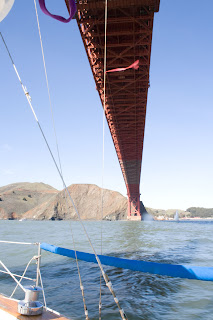
As I neared the south shore, I got the view you see to the right. Under the rightmost portion of the span you can see San Francisco. Just to the left is Alcatraz.
Just past the bridge, there was a distinct change in conditions. I could feel and see a 2 - 3 foot swell rolling in off the Pacific. This mixes with the local currents and the topography of the bottom to produce a stretch of water along the south shore known as the Potato Patch. It is aptly named. The water is lumpy and bumpy.
The last time I passed through this patch of water in 1982, I was helping my friend, George, move his boat down the coast to Santa Cruz. I made the mistake of going below to try to do some calculations for a sun sight that I had taken to keep myself in practice doing celestial navigation. I was immediately, violently seasick. That was only the beginning. I was seasick for the rest of the trip. We took two hour shifts steering the boat during the night. Every half hour or so, I would have to lean over the rail and try to empty my already empty stomach. Not fun!
I am happy to report that this was not the case today. I managed several more tacks before turning back toward home. I took this picture just before turning back.
I look forward to the day when I get to this point and keep on going!
 Going back, I was going downwind. That meant that the boat speed was subtracted from the apparent wind and the day now felt warm and balmy. Going downwind, Laelia is not a lot of fun to steer. She wants to veer left and right as she rolls. With the swell rolling in, she was doing a lot of rolling and veering. Possibly, you can see a bit of the swell running in this picture. The Marin headland (north shore of the Golden Gate) is to the left.
As I passed under the bridge, I turned a bit to port to head toward Sausalito. Now the wind seemed to be in a place that would let me run wing and wing. It turned out to be a frustrating exercise. As the boat rolled, the jib would collapse and dump the wind. After the boat rolled a few times and the wind was just right, the jib would fill with a loud BANG and the whole boat would shake. I was afraid this would break something or split some seams in the jib so I gave up on that idea and gybed. If I had Laelia fully outfitted and we were on the open ocean, I would use a pole with one end attached to the main mast and the other to the corner of the jib. This would keep the jib from collapsing. I would also have a line running from the end of the main boom to the bow (front) of the boat to hold the main well out to the side and to make sure that it didn't swing across the boat in one of the rolls - an accidental gybe - and break some of the equipment.
Gybing is a delicate maneuver. Today the wind was coming from behind the boat and the main was on the port side of the boat. I wanted to turn far enough to port to get the main to come across the boat to the starboard side. If I just turn the boat until the main comes across by itself, it will swing across suddenly, fill with wind and slam against its sheets (ropes). With the amount of wind there was today, that would probably break something. I spent about five minutes pulling the main in with one or two hands and steering the boat with the other hand. Laelia was doing her trick of veering with each passing swell so it was a juggling act until I could get the main pulled in almost to the centerline of the boat. Then I could turn and let the main come across without damage since it could only swing a very short distance before getting to the end of its rope.
I had a very pleasant sail past Pt Cavello and the Sausalito waterfront and started dropping sails after I passed the Spinaker Restaurant.
Getting into the slip was more interesting than usual today. There was a significant cross wind blowing from left to right as I entered the slip. It doesn't take much wind to push the boat around so I was at bit nervous about the whole maneuver. I managed to get in without any damage. I wouldn't call it graceful but it worked.
It was another good sail with more lessons learned. I need to add reef points to the main so I can reef (pull it part way down) and not have a bunch of sail flapping in the breeze. I really, really need a wind vane to steer the boat while I manage sails. It would have been extremely difficult - if at all possible - to deploy the pole to hold the jib out when I was running down wind without something to steer the boat for me. I need to have the pole set up so it is easier to get it into position. These are all things that are not too hard to remedy - given time and money.
It was tantalizing to be outside The Gate and looking south past Land's End. Another tack or two and I would have been in the clear and able to run south. The day will come!
A boat is a collection of a huge number of details. A bunch of them get taken care of by the builder. Some more have been taken care of for me by previous owners. There still are quite a few left for me.
On my short outings so far, one of the details that I have been reminded of is the lack of tell-tales on the boat. Sailboats are dependent on wind. The direction and strength of wind is what tells me which sails to use and how to trim them. When the wind is blowing more than about 10 knots, it is not too hard to get the general idea about where the wind is coming from. When the wind falls light, it is harder to tell. Even when the wind picks up, it helps a great deal to have a visual indicator to figure out the exact angle the wind is making with respect to the boat.
Without some form of wind direction indicator, I am left to the old-time devices to figure out wind direction. Face into the wind and feel the cooling breeze on both cheeks. When they feel the same, I am facing into the wind. Alternatively, turn my back to the wind and feel the breeze on the back of my neck. When it feels like my neck is being cooled equally on both sides, I am looking dead down wind. These indicator are easily invalidated by physiological factors and even the clothes I am wearing. When the wind is quite cool, one cheek gets slightly numb and the balance of feeling is destroyed when I look into the wind. When I am wearing foul weather gear with a hood or even when I wear a life vest, the back of my neck is partially covered and that source of information is useless.
There are expensive bits of electronics that use a wind vane mounted at the top of the mast. The direction the vane is pointing is reported by a display mounted in the cockpit. Laelia has one of those but according to the display, the wind always blows straight across the starboard rail at right angles to the boat direction. If I were a wealthy yachtsman, I would call an electronics repair guy and have the problem fixed. That may happen someday but in the mean time, I need a less expensive way to deal with the problem.
 That's where the tell-tale comes in. A tell-tale is just a piece of fabric tied to a shroud to help me figure out exactly where the wind is coming from. In the picture to the right, the tell-tale is the little red streamer flying from the shroud toward the right side of the picture.
For once, I didn't have to go to West Marine and part with my all-too-scarce dollars to add something to the boat. I stopped at North Sails and asked for some scraps of spinnaker cloth. They gave me one big enough to take care of my need for tell-tales for years to come. Spinnaker cloth is very light weight nylon with extra threads in it to make it rip resistant. When I cut it into narrow strips like this (1/2" x 6") it flies in the lightest breeze and gives me a good visual clue to wind direction.
Ah, would that it were so easy to tell which way the winds of fate blow. Knowing which way to turn in my life seems a dark mystery at the moment. I keep having tantalizing contacts with people who tell me my perfect job is out there and they will put me in contact with the company that will hire me. So far, that has resulted in two phone screen interviews and no offers. Without a job and money coming in, I can't do much more than go for occasional daysail trips, do basic daily maintenance and pray that nothing expensive will break.
To add to the money woes, when I figured out our taxes for 2011, I discovered that I had made a mistake and not nearly enough money was withheld for income tax. That adds to the urgency to find a job and start having some income.
On the positive side, Judy and I are making our peace with our differences. We have been wrestling with the changes in our situation and the effects on our relationship since I retired in June and especially since I bought the boat. We know we love each other and that it is important to keep our relationship alive. I will be spending more time in Placerville with Judy and less time on the boat for now.
But even this development is shrouded in uncertainty. I need to work and I will have to go where the work is. There's not a lot in the Sacramento area so I will most likely not be able to stay here in Placerville. Hopefully, something will turn up in the SF Bay area so I can at least get home on weekends.
In the mean time, I will be spending a couple of days a week on the boat doing whatever I can to get ready for the voyage. Our weather has been unusually warm and sunny for this time or year. I hope to take advantage of some more of those days. That will include going sailing and putting those tell-tales to work to tell which way the wind blows, how to trim the sails and how to set my course.
As for the winds of fate, I still have no tell-tale. Time will tell which way those winds blow.


