Wednesday, July 2, 2014

Back in La Paz


Following the last post, things started falling into place – mostly right on top of us. The sale of the Placerville house and the purchase of the house in Citrus Heights went without any further hitches. A frantic month followed. Judy had negotiated a 30 day rent back on the Placerville house. That 30 days was used to do a LOT of work on the new house. The house appeared to have not been updated since the mid 80s. The carpets were in bad shape. The paint was old and the family room had dark wood paneling on the walls. The window coverings were old, yellowing venetian blinds. Overall, the house was dark and depressing.

I pulled out all of the old carpets except the living room to get ready for installing new flooring. We ended up with Pergo Antique Oak flooring everywhere except the living room and the bathrooms. The bathrooms have new vinyl tile. Looks great! Judy talked me out of doing the installation. Good thing! I could not have done it as quickly as the pro did it and we were pressed for time.

We had the interior completely repainted. We replaced most of the ceiling fixtures except for the ones that have fans.

The master bath needed a new counter top and sink. Replaced toilets in both bathrooms.

All this activity was interspersed with frantic shopping trips to find just the right pieces to do the updating. Oh yes, we were packing for the move during this time as well.

Moving day came and the new place was pretty much ready. The house is amazingly lighter and happier feeling. We managed to carry along much of the decorating theme that we had and loved in Placerville albeit in a smaller space. The kitchen is tiny compared to Judy’s dream kitchen in Placerville. We lost about 300 sq ft of space in the move.

The smell of new paint and out-gassing from the new flooring was eye watering. We lived with the windows open as much as possible for the next couple of weeks. Fortunately the weather cooperated and we were able to have the windows open all night and much of the daylight hours.

We hired a moving crew who finished the packing and loaded the truck – a 26 ft Penske van. Mostly they did a good job but they were definitely not professional movers. Some things got broken and banged up even though the move was less than 50 miles. They showed up at 11 AM to begin packing and loading. They finished just before midnight. By the time we paid them, found the things we needed to take showers and make beds, it was almost 2 AM.

One of the rooms of Hell must be one where you wake up in the morning in a bedroom full of boxes to be unpacked. You stumble into the kitchen to make morning coffee and spend half an hour or more looking for the coffee and the pot. And the day goes downhill from there. To add to all this, Judy’s allergies went into high gear with all the house dust, cardboard dust, out-gassing materials and the Sacramento Valley air quality. But, as usual, she soldiered on and we gradually began to bring order to chaos.

By the time I left on July 1, we were down to the last stubborn boxes. Some of these contain things that need to be winnowed out for the down sizing – a painful process. The new window coverings arrived the day I left. Judy says they look great.

In the background of all this,  I had been trying to get the new sails and get paid for the trip home to pick them up. The sails did finally show up – two days after the date of the return trip I had originally booked. This despite repeated promises that they would be ready the first week in May. Also, I am having trouble getting Hood to make good on the promise to pay for the trip home. They figured that was the cheapest and safest way to get the sails to La Paz – their idea. As I understand it, they are trying to weasel out of paying by saying that I would have made the trip home anyhow to help Judy with the move. This completely ignores the fact that I would have turned around back in April and sailed home except that the sails were falling apart. I am still working on them to pay up.

The trip from Sacramento was about what you might expect – long. My flight left Sacramento at 0930 but I had to be there two hours early since I had booked an international flight. I ended up breaking the sails up into two packages which just barely qualified as standard luggage. The heavier one was 45 lbs. I had the bundles tightly tied up with clothesline – and handles made of clothesline. That stuff is not a comfortable way to carry heavy luggage!

On arrival at San Jose del Cabo, I spent at least half an hour arguing with customs that I should not have to pay import duties since the sails were replacement parts for a boat in transit. I lost. I did get them to reduce the import duty to about 1/3 of the original amount they mentioned.

After paying $160 to get the sails past customs, I sat outside waiting for my ride to La Paz. There were two tropical depressions lingering offshore to the southwest bringing unusually moist air to add to the 90+ degree temperatures. My scheduled ride with EcoBaja Tours showed up on schedule. A three hour ride followed. We went into Cabo San Lucas to pick up another passenger then proceeded up MX 1. There were some wonderful views of desert leading down to sandy beaches and the sun setting into the Pacific.

As we approached La Paz, we saw evidence of the side effects of the dying tropical depressions. A strong thunderstorm had come through La Paz in the afternoon dumping lots of rain. There were numerous places where dirt side roads has washed out onto the four lane highway we were on. Some lanes were flooded. On the other side of the highway, there was a car upside down in one of the big puddles. A couple of police vehicles were directing traffic and keeping a crowd of bystanders out of the way.

I got back to the marina a little after 9 PM La Paz time (Mountain Time in the USA). The tour bus driver very kindly dropped me at the marina instead of taking me downtown to the terminal. That got me home at least half an hour sooner and did not require a taxi.

The first thing I saw as I approached the boat was that the lightweight sun covers had gotten shredded by the wind in my absence. I had expected that. I was prepared for the worst inside the boat. It had been closed up for two months in the heat and humidity.

My fears were mostly not met. The boat was quite stuffy and warm. With only a little breeze to cool it, it took until after midnight to cool the interior to the point that I could sleep.

The refrigerator had failed while I was gone. I rather expected this. I would not have left it turned on with food in it had I known I was going to be gone for two months. Oh well, the refrigerator lid was closed tightly so it didn’t smell too bad. I left the clean up for the next morning.

It is a strange feeling to be in the place that I have known so intimately for the last 2 ½ years and feel out of place. I had gotten used to being at home with Judy again. She is not here. I don’t have a big clean bed where we can snuggle up in a cool room at night. This morning, I am stumbling around trying to find all the things I need to make breakfast and have my morning coffee – things I used to do on autopilot.
 
This is one of the few times in my life that I have flown from relatively cool, dry climate into hot, damp climate. It takes some adjustment. This morning finds me feeling very sluggish - hard to dive into the work that needs to be done.

Well, enough whining and procrastinating. Time to get on with the work. I have some cleanup to recover from the effects of being closed up for so long. Then I need to get the boat ready for the return trip. It shouldn’t take much – everything is pretty much as it was for the trip down. I should need only some food and a few miscellaneous small repairs.

The plan is to take the offshore route back to San Francisco. That means that I sail South to Cabo San Lucas then out into the Pacific toward Hawaii. I will be monitoring the location of the North Pacific High in the hope that I can catch the most favorable winds. I am estimating about 30 days at sea for the return unless I get really good or bad conditions. The best thing that could happen is for another tropical depression to start up the coast of Mexico and pass about 200 miles offshore as it passes Baja. That would give me a good wind out of the south and speed me homeward.

I hope to be out of La Paz within the week. We shall see. As always, I will be posting on Facebook via the inReach communicator while I am out of Internet range. You can see my latest position on a map by going to


Thursday, May 1, 2014

The Next Step

Following the previous post, I fell into Limbo. I was waiting for word from the sail maker about my replacement sails. I was (still am) debating the best strategy for getting Laelia back to the San Francisco Bay area. And - not least of all - I was wondering what my reception would be when WiI got back home to Placerville. Judy and I had been exchanging lengthy emails trying to figure out if we would be able to put our marriage back together.

Limbo is a depressing place to live. I found that it was getting harder and harder to get out of my bunk in the morning and carry on with daily life. I had a few minor repair and improvement jobs on my agenda but I lacked the will to get into them - with one exception. Repair Laelia's head.

For the landlubbers in the audience, let me explain about "the head." It is the nautical equivalent of a toilet. On a small to medium size sailboat, the head consists of the usual toilet bowl but instead of a tank holding water to do the flushing, the flushing is accomplished by using a hand operated pump. Now, a pump has moving parts that operate under considerably more stress than the few moving parts of the common land based toilet. There is a cylinder with a piston in it that supplies the pumping action. There is a flapper valve that opens to suck "stuff" out of the bowl when the pump handle moves up and then closes to keep it from flowing back when the handle moves back down. The "stuff" is pumped uphill a two or three feet to get it above the waterline so it can flow down hill into the ocean or the holding tank. To keep the "stuff" in the output line from flowing back into the pump, there is a check valve. The check valve is a piece of rubber shaped like a flattened baby bottle nipple. It doesn't move much but the part that does move is critical to keeping the "stuff" from flowing back into the head.

I was strongly motivated to make this repair despite the obvious grossness factor. Without getting too graphic about it, let me just say that it was not flushing properly and some "stuff" was draining back into the bowl and smelling worse every day. I spent one longish morning disassembling, cleaning, replacing non-metal parts and reassembling Laelia's head with the temperature in the cabin getting will up toward 90 degrees and no breeze to either cool the cabin or dispel odors.  Disassembling the moving parts revealed a coating of "stuff" on the check valve in the output line that allowed "stuff" to drain back into the bowl instead of being held safely out of sight and out of smelling range. The problem was exacerbated by the coating of "stuff" on the flapper valve that kept it from closing fully.

Much to my relief, when I finished cleaning and reassembling the unit, it worked as it should. No more back flow. No more odors.

The remaining small jobs lacked motivating factors anywhere near as compelling as the head repair. I began hiding out from the uncertainty in my life by burying myself in a mountain of paperback books. I read a lot of science fiction by Poul Anderson, Hitch 22 - a memoir by the late Christopher Hitchens and miscellaneous other paperbacks. I had loaded up two shopping bags with used paperbacks on one of the last weekends in Placerville. As I read these books, I took them ashore in La Paz to Club Crucero (the local cruising sailors yacht club) and exchanged them. I was in no danger of running out of hiding places.

But that still left the night. I was having trouble sleeping - wondering how all these loose ends were going to come together. By far, the most upsetting was not knowing where I stood with Judy. Email has been both a blessing and a curse as we tried to figure out where we stood with each other. The printed word does not carry tone of voice or facial expression magically embedded in the text. There were misunderstandings and uncertainties that just would not go away. Finally, I could not stand it - I bought a ticket to fly home. I booked a flight with a return date of May 13th which should give us almost three weeks of face to face time to see where we stood. It should also be enough time for the sail maker to complete the new sails and ship them to me in Placerville.

The least expensive flights out of La Paz to Sacramento go by a roundabout course that requires almost 24 hours of travel time and would get me into Sacramento at 1 AM. Not wonderful! It turns out to be better to take a flight from San Jose del Cabo near Cabo San Lucas. It is cheaper and requires only one stop at Orange County (John Wayne International).

To get to the airport, I found a bus/van that went directly from La Paz to the airport with one rest stop - a total of about three hours. The trip down Mexico Highway 1 turned out to be quite pleasant. Once out of La Paz, Highway 1 is fairly narrow, two lane, winding road. The scenery is mostly desert but very interesting desert. There are scattered small towns that pop up in the middle of nowhere. There is no apparent reason for their existence - but there they are. Each of these small towns had a series of speed bumps to keep the traffic from speeding through town. Why bother with expensive traffic lights to regulate traffic when a nasty bump in the road will do the job?

The San Jose del Cabo airport is a fairly typical modern looking airport with a moderate amount of traffic. I suspect most of the passengers are going to and from Cabo San Lucas which has become something of a hot spot for "with it" young travelers. There is, of course, the Mexican equivalent of TSA at the airport. I donated a nice pair of scissors from my hair cutting kit to the very pleasant young man who pointed out that I could not take them in my carry on luggage.

Clearing customs at John Wayne International was a matter of standing in line for about 15 minutes, presenting my passport and being waved on through with no further ado. I had almost three hours to sit and read a big chunk of "Inside Outside" by Herman Wouk - an interesting and sometimes hilarious account of a young Jewish man growing up in New York in the 20s and 30s struggling with his religious identity, a romance with a non-Jewish show girl and a stint as a gag writer for radio shows. I covered another two hours worth on the flight from Orange County to Sacramento.

I will have to admit to feeling trepidatious as I joined the herd of passengers moving from the airplane to the baggage area. Judy greeted me with an almost shy smile, a hug and an enthusiastic kiss that led me to believe that she was as happy to see me as I was to be with her again.

The following days have reinforced that. We have done a lot of talking about what we each want when (not IF) we are back together. I can't say that we have all the answers worked out but we are committed to being back together and picking up where we left off as best we can. Obviously, we can't and shouldn't ignore the events of the past couple of years. We have learned that we have difficulty communicating on some issues in our relationship and we both want to work those out. But all those things that brought us together in the first place are still operating - reminding us that we DO belong together.

An interesting challenge has surfaced. Judy put the house up for sale. It is located on two acres of what used to be a plum orchard just outside Placerville. We both have come to the conclusion that it is more than we want to try to keep up with. Additionally, Placerville, while picturesque, is lacking in activities that interest us. Judy had planned to move to Sacramento to a smaller house near her son and his family. In less than a week, she accepted a nearly full price offer on the house. This provoked a panic since she had not yet found a house she liked in Sacramento. Fortunately, her son Doug knew a realtor who he promised would find a house for her - quickly. And she did.

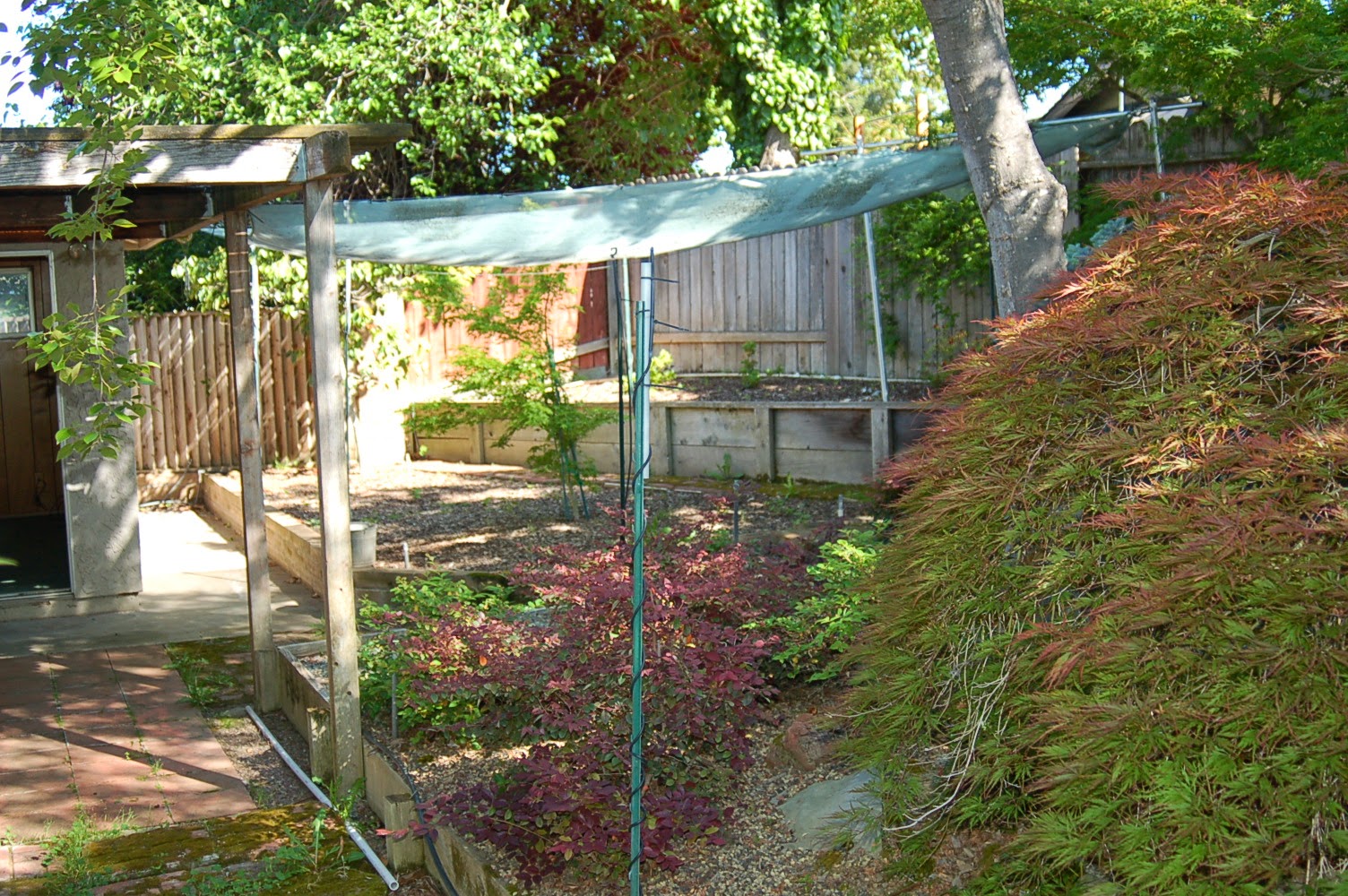
Judy fell in love with a house with a wonderfully landscaped, peaceful back yard on a small lot and made an offer. The house had been on the market for less than 24 hours. Her offer was accepted and shortly after that, the seller's realtor called Judy's realtor to let her know that the seller had received two more offers - one full price and one above asking price. The market is hot in Sacramento!

I had planned to return to La Paz on May 13th - three days before closing on the house in Placerville. I am now planning to put off my return to La Paz until sometime around July 1. Judy has been able to work out a 30 day rent back that would give us some time to get the new house in shape. The house was built in 1977 and is in excellent condition but it needs a lot of updating - new flooring, new interior paint, etc. Not unsurprisingly, she was in a bit of a panic about getting the work done as well as the packing and moving. With the two of us working on it, it will still be a crunch but it will get done.

That is where things stand at the moment. All the nitty-gritty stuff surrounding real estate transactions is grinding forward. No great surprises so far - just irritating little things. The inspection on the Placerville house revealed that the three water heaters in the house are not strapped for earthquake safety as required by California building codes. That's not all that surprising given that each heater is about 10 gallons and is quite short. Nonetheless, there are no exceptions! If we don't strap them, FHA will not approve the buyer's loan.

Sailing home from La Paz will be an interesting proposition. The hurricane season officially begins in June although it is fairly unusual to see a hurricane in Baja before August. The tropical depressions and hurricanes that form in the Gulf of Tehuantepec can give rise to southerly winds that can make it easier to sail up the coast - or turn it into a nasty, potentially fatal, hair raising experience. It will require that I closely monitor the weather and duck for cover if bad weather is coming.

The trip is not over - and the remainder promises to be "interesting."

Tuesday, April 8, 2014

OK! Now what?


OK! Now what?

I set out to circumnavigate. That is not going to happen, so now what?

Assuming that Judy wants me to come home, there is one big problem facing me. What to do with Laelia. The obvious solution is to turn around and sail back the way I came. There is a problem with that. The trip here was mostly down wind. Although it had its rough spots, it was not a terribly difficult ocean passage. Going back, Laelia would be going upwind – not her best point of sail. At one point on the trip down here, I attempted to turn around. I spent four days bashing into oncoming wind and waves – very rough! It is the kind of sailing that causes equipment to fail and boat parts to break. On top of that, in a rough sea, the best Laelia can do is to sail about 70 degrees off the wind. If the wind is coming from the direction I want to go (which it would be most of the time), I would have to sail almost three miles for every mile that I made good toward my destination. From Cabo to San Diego is a little over 800 miles. I would be tacking back and forth for 2400 miles, getting beaten up by oncoming wind and waves. If I want to bring Laelia back to San Francisco Bay, add another 1500 miles of sailing. In my mind, this is not really an option. The cost in physical effort and broken equipment would be greater than I am willing or able to deal with.

However, there are occasions when the wind shifts and blows from the south. It happens during the Winter. The winds are light but from the right direction. It also happens in the Fall when tropical depressions and hurricanes form in the Gulf of Tehauntapec and move north. They normally turn and head off to the west into the Pacific before they get to Baja – but there have been notable exceptions. As they move, they generate some strong south to southwesterly winds. Assuming that I didn’t get unlucky and get caught up in one of these exceptions, I could ride the fringe winds northward. Of course, it is not certain that this will happen. Remember the 800+ miles to be sailed. Under the best of circumstances, it is seven or eight round-the-clock sailing days to make the trip. It is not likely that the winds from a given storm would last long enough to cover the full distance. The schedule for a trip using this strategy would be unpredictable and probably would not allow a start in the next few months - but it is possible.

That leaves “The Clipper Route.” This means sailing mostly downwind from Baja, mostly toward Hawaii until the winds curve around and allow me to sail north without the wind coming from straight ahead. It might even be best to sail to Hawaii, rest and recuperate, then sail Hawaii to San Francisco Bay. Baja to Hawaii would take about 25 days. Hawaii to San Francisco would require another 35 days. Let’s call it three months from start to finish. If I left in mid-May when my new sails are ready, I would get home mid-August. It is possible.

The fourth option would be to sell Laelia here in La Paz. I have talked to a broker about this. Obviously, he wants the business and paints a fairly rosy picture. I can’t actually sell Laelia here. The broker arranges an off-shore transaction which means that the boat is not sold In Mexico or in the USA. It means that sales taxes on either end would be avoided. Knowledgeable buyers are interested in La Paz boats because they have been sailed down here. They are out fitted with serious cruising equipment and are, on the whole, much better equipped than the average boat sold in San Francisco or San Diego. The down side is that it is not likely that the sale would happen in a short time. Buyers want to be pretty sure of what they are getting into before they spend the money to come to La Paz, look at the boat and have it surveyed. Laelia has to have a home during that time. Slip rentals are about 50% higher here for non-live aboard slips - $600 to $700 per month for a Laelia-sized boat. If it takes a year to sell (not unusual) I will have spent $7000 on slip rental. Not an attractive proposition. So far, this appears to be the best option - but I'm still looking.

There is one other option – move the boat to San Carlos (across the Sea of Cortez from here), have it put on a truck and shipped to the desired location. I’ve heard estimates of $6000 to $7000 for that. Given the state of my bank account at the moment, this is not really an options.

So, gentle reader, that’s the situation. Those are some possible answers. Perhaps you have another. Don’t be shy – email me at SailorRalph365@gmail.com. I will give serious consideration to all but the wildest ideas.

Of course, there is the possibility that Judy will decide that I have abused her love and trust beyond repair. I wouldn’t blame her. In that case, I would probably keep Laelia for now, apply for an extended Mexican visa and live aboard here in Baja for some length of time. If I were to anchor out most of the time, my expenses would be minimal – the slip is the expensive part of living here.

But it would be incredibly lonely without MiLuv.

I hope it will not come to that.


Impressions of La Paz


As I related in the previous posting, one of my very first impressions of La Paz wasn’t all that good. Being stuck on a sandbar in the harbor does not do a lot to make me feel warmly disposed. However, that has fast dispelled. I will start with the cruiser scene since that’s what I saw first.

For starters – the weather here has been wonderful. It is a bit on the warm side and getting warmer but there is lots of sun, clear, sparking water and blue sky – much like Hawaii. It calls to me to relax, be happy. Moving back from the waterfront, it rapidly gets warmer and more arid looking. This is a desert even though it is surrounded by water.

I was fortunate to have my friends on Rocket Girl here to give me a few quick clues about the way things are here. For starters, there is the big party line in the sky. Most people monitor VHF channel 22A. It is used as a calling frequency with conversations held on other channels. A typical hook up on 22A starts out with something like “Wanderer, Wanderer. Laelia.” If Wanderer is listening he/she responds “Laelia. Wanderer. 65 and up.” That means that I should shift to channel 65 and call again. If that channel is in use, got to channel 66, etc. A certain amount of eavesdropping goes on – not that anyone would be silly enough to carry on an intimate conversation – but there is a lot of interesting activity in the harbor.

Mornings, except Sunday, there is a cruiser’s net (network) that meets on 22A – probably the only exception to using the channel for hailing. The net is run by someone on one of the boats here. It starts with asking for anyone with emergency, medical or priority traffic. This is when you jump in and ask for help with your salmonella, appendicitis, etc. Following that (not in this exact order) there is mail call – the local marinas and other common mail drops announce the mail they are holding. There is a swap and trade segment. Foreigners are not allowed to sell things in Mexico but there is a suspicious amount of trading going on for “coconuts.” There is a segment for people wanting rides or going someplace and willing to take passengers – another for help wanted/help needed. Another segment is for announcements about events of interest to the cruising fleet. The net wraps up with a call for general messages – anything that didn’t get handled so far.

Preceding the net, there is a discussion group meeting on another channel to hash over current events. The moderator reads off something that he probably pulled up on Google. People may make comments. The comments range from thoughtful and intelligent to clueless. Still, it tends to be interesting. Participants may also bring up any news item that they think may be of interest.

The community here in Marina de La Paz seems divided into two fairly distinct segments. There are the active cruisers and the long-term live-aboards. The long-term live-aboards tend to be older and somewhat cliquish. The cruisers are mostly here in the marina for a month or less to make repairs and get organized to move on. The cruisers tend to be more gregarious and quick to offer help.

Overall though, the atmosphere here in the marina is relaxed and friendly. I enjoy it.
But I didn’t come all this distance to live in the marina. My first expedition out was a simple walk down the Malecon (boardwalk). La Paz is justifiably proud of its Malecon. The water is clear and inviting. The beaches are white sand. There is a wide, undulating sidewalk behind a knee high wall separating the beach and the Malecon.


There are interesting statues ranging from a very new creation of a mirrored pearl in an open shell...


...to a mermaid hanging onto a dolphin


...to a very puzzling statue of a man wearing what looks like a small boat sideways at his waist.


Despite this being the tourist section of a town that is a tourist destination, people on the Malecon are overwhelmingly Mexican in appearance. There is a small percentage of people (like me) who are obviously tourists enjoying the sights. People look relaxed, happy and prosperous middle class in appearance.

Oddly enough, even though the traffic is fairly heavy on the street paralleling the Malecon, there are no traffic lights. Some intersections have four way stop signs – some don’t. Despite that, traffic flows smoothly. I have heard only a two horns. One appeared to be friend honking at friend – light taps on the horns. The other was someone who obviously unhappy with another driver at a four way stop. The car doing the honking was coming from the marina street so he may well have been an impatient, rude Norteamericano.

The far side of the street is lined with shops, restaurant, hotels and other small businesses. A surprising number of the hotel-like structures appear to be unused. A fair number of the small shops are empty – some boarded up. It is an odd contrast of bustle and ruin.

There are sidewalk vendors and taxi drivers hanging about looking for business but for the most part they are fairly reserved by the standards of the run of the mill USA beach front. The only time I have been approached by one of the taxi drivers was when I was walking back to the boat after shopping. I was carrying a backpack full of food and a shopping bag with some more items. A simple “No, gracias” was all it took to discourage him.


Yesterday, I went grocery shopping for the first time. I decided to walk some of the streets a few blocks back from the Malecon. The first thing I noticed was that the city of La Paz seems to have put street signs at a low priority. Only about one out of four intersections have any sort of sign proclaiming the names of the streets.


I would have to say that sidewalks very much appear to be an afterthought. For the most part, they exist but they range from unpaved paths to narrow concrete slabs to elegant, wide, tile paved spaces.

The commercial and residential district are not rigidly separated in this section of town. A car repair shop stands on a corner flanked by residences. There are numerous vacant structures – maybe one out of five. Some appear to have been unused for quite some time. The structures are mostly concrete slab so they are not tumble-down – just unpainted and dilapidated looking.

When I reached one of the busier streets, the buildings were mostly shops with apartments and offices on the upper floors. Again, there were a surprising number of unoccupied shops and some entire buildings.

All along my walk I met people who smiled and greeted me. In front of many of the shops, a portion of the staff were standing and conversing with other shop keepers, by passers and friends. The overall impression was still one of friendly, happy people in no hurry.

The Super Mercado (super market) resembled the small grocery stores of the 50’s. It was not large – perhaps a quarter of the size of the average Safeway. The aisles were narrow. There was a surprisingly good selection of vegetables and fruits. Canned and bottled goods were similar to the ones we find in supermarkets but only one or two different brands of each item. The staff was friendly and tolerated my attempts at Spanish with smiles. It all worked out.

On my way home from the Super Mercado, I picked up a small, free English language newspaper that appears to be sponsored mostly by the local realtors who are selling to the gringo market. There was a long column bemoaning the fact that the big box stores are pushing out the smaller, family owned stores. Just off-hand, I know that Sam’s Club, WalMart and Costco are here along with Sears and Home Depot. An old, small store might have a limited selection of goods, but there were a lot of stores and a buyer could eventually find the desired item. This is being replaced by the big stores that have wide selections, well organized displays and fast service. Sounds a lot like small-town USA from the 70’s to now.

Overall, I would have to say that I like La Paz a lot. I might not want to be here later in the summer, but for now, the weather is wonderful. People are friendly, they smile a lot, they don’t appear to be in a big hurry. La Paz has the reputation of being the second safest city in the Americas. No drug wars are going on here. It is a tourist destination but not intensely so. When I got a few blocks back from the beach area, people appeared to be almost entirely Mexican. The stores looked like they catered to locals – not tourists.

I wonder what it would be like to live here a year – see the city through the seasons, improve my Spanish, get to know more of the residents. Who knows – it might be hard to return north after that.

Monday, April 7, 2014

Cabo to La Paz


I left Marina del Puerto Cabo feeling down and depressed. The forecast was for little or no wind for the next few days. I don’t have an autopilot so that means steering by hand all the time under power.

Despite that, my spirits rose once clear of the marina and out onto the Sea of Cortez. I was moving again, the air was warm and the scenery was quite arresting. Blue sky, blue water – CLEAR blue water. Looking over the rail, it felt like I could see down forever into the deep blue waters.
 
As I moved offshore, I watched the coastline drift by. There is a lot of development going on in the vicinity of San Jose del Cabo as you can see from the picture at the right. From the marina entrance until I rounded the first cape about 10 miles north, there was a steady procession of what appears to be new construction. I hope the Sea of Cortez can withstand the encroachment!

Once past the first cape, there were no other boats within 10 miles or so. I was a good five miles offshore. There were no more buildings lining the beach. Hmmm. Good time to work on my all-over tan. In short order I was motoring along dressed in just hat and sailing shoes. But only for about an hour. The Baja sun is pretty intense – especially on white, gringo skin that rarely sees the light of day. But what a freeing feeling it was for that hour.

The rest of the day was hot and uncomfortable. I was motoring at 5.5 knots and the wind was mostly from behind at about the same speed. That meant that much of the time I was feeling no breezes across the deck. The boredom was relieved briefly in the morning when I spotted what look like waves breaking against a rock directly ahead of me. I altered course to miss that spot – just in case. I was supposed to be in over 400’ of water. I soon realized that what I had seen was a whale surfacing just long enough to breathe and then diving. He/she did it again much closer to the boat. It was done all in one smooth motion – a bit of the head appeared and went back under followed by a LOT of back and finally his flukes came out of the water and disappeared again. He went by maybe 20 feet to port, well submerged. Comparing his length to the boat’s length, I would guess that he was over 20’ long. I saw him repeat the breathing process at about one minute intervals until he disappeared.

It was a welcome change to anchor in the bay at Los Frailes (the friars – priests, that is) and have the full five knot wind coming over the bow as Laelia’s anchor took hold in the sand bottom. Anchored in almost 30 feet of water, I could see the anchor on most of its trip to the bottom. Looking around, I was surrounded by sparkling waves, white sand beach and arid desert landscape. Gorgeous!

Los Frailes appears to be mostly deserted. There were a few houses, widely scattered, and a collection of campers who appeared to be fishermen of the tourist variety. One hailed me as I anchored and wanted to know if I had caught any fish. I’m guessing he hadn’t and was hoping to buy dinner.

After dark, it was dark – really dark. The moon did not rise until much later in the evening. With no man-made lights to compete, the stars put on a spectacular show. I could easily find my old friends – Ursa Major (big bear aka the big dipper), Polaris (the north star), Ursa Minor (little bear/dipper), Orion, Sirius – stealing the show by out shining all others, Betelgeuse and uncountable other. I woke up a few hours before dawn to find Venus low in the eastern sky looking as bright as an oncoming airliner.

After a relaxed breakfast, I got under way - 8:30ish. The leg from Los Frailes to Bahia de Los Muertos (Bay of the Dead) was a full eight hours of motoring with the wind dead behind me at boat speed all day. I put in another hour on my all-over tan in the morning before the sun got too intense, then cooked the rest of the day.

I say another whale – too far off for details and too quickly to get any pictures. Judging by how long it took from the time his head appeared until his flukes waved goodbye, he was a monster.

By the time I reached Bahia de Los Muertos, I was pretty miserable. I couldn’t stand the smell when I got downwind from myself. The logical thing to do was to jump overboard to cool off. Unfortunately, I don’t have a way to get back aboard the boat. The deck is a full three feet above the water and I have no boarding ladder. The next most logical solution was to empty out all the stuff I had been storing in the shower and actually take a shower. Radical concept! But I was desperate enough that it took only about five minutes to prepare the shower. It had been long enough since I used the shower that I forgot which knob was hot water and nearly scalded myself with water that was heated by the engine to just below boiling. Once I got that all straightened out, the shower – complete with shampooing my hair – was an unqualified blessing. The breeze that had been following me at 5 knots all day had risen to closer to 10 knots. Since I was securely anchored, I got the full benefit of all 10 knots.

I seized the opportunity to cut my hair. The 10 knot breeze meant that I could stand at the aft end of the cockpit cutting hair and it all blew overboard. No muss, no fuss. That added to my feeling of having shed a heavy mantle when I showered.

There were several homes and a restaurant on shore as well as a collection of fishermen similar to what I had seen in Los Frailes. There were five other boats anchored nearby. Judging by the total lack of activity on any of them, they must have been ashore – probably enjoying the restaurant. I was too tired to launch the dinghy and row in so, once again, I fixed dinner of canned stuff and crashed shortly after dark.

For the next day, I had the option of 10.5 hours of motoring and getting into La Paz as dusk was falling or settling for a mere 8 hours and anchoring at Puerto Ballandras abou 15 miles short of La Paz. I opted for the latter. Sailing into a strange port with darkness falling is not my idea of fun!

The days’ motoring was tolerable. There was a light breeze from abeam most of the day, moving around toward the bow as the day wore on. If I hadn’t had such a tight schedule and I could afford to sail into the night, I could have sailed for the last few hours.

Puerto Ballandras (at right) is a dent on the western side near the tip of the peninsula containing La Paz. It gave good shelter from the NW wind but there was enough swell that Laelia had fits of violent rolling durng the night. Looking out the next morning, I could see that the other boats were doing the same thing. I felt better. Misery loves company!

It is a curious thing – this phenomena of intermittent violent rolling. I could stand on deck and see no change in the wave pattern but every now and then, Laelia would start a slow oscillation from side to side that got bigger and bigger over a 5 – 10 second interval. The oscillation would build to a climax and then suddenly stop. No tapering off – it just stopped. The boats in the anchorage seemed to take turns doing this. I suspect that the rolling is influenced by boat hull shape, weight and rigging configuration.

I got under way a little before 9 AM, hoping to be tied up in the marina by noon. Fate decreed otherwise. The day did not go well after I cleared the bay. I had plotted out a course using software on my laptop. I downloaded the information to my hand-held GPS receiver. At the second waypoint after leaving Puerto Ballandras, my GPS device was telling me to steer a course that would shortly have me on the beach. Much head scratching and muttered cursing ensued. What I could see trumped what the otherwise infallible electronic device was telling me. After consulting my paper chart, I steered a course to stay a mile or so off the beach. The waypoint that was supposed to put me at the entrance to the channel leading into La Paz harbor appeared to be correct. I steered Laelia to that waypoint and looked for channel markers. Nothing! I kept motoring in what appeared to be the right direction and in short order I was aground. The good news was that the bottom was sand and mud – not rocks. Also, the wind had picked up and was creating little waves that would pick Laelia up far enough that she would move a few inches or a few feet.

Just after I hit bottom, I spotted a channel marker about ½ mile to port. I got Laelia pointed in that direction and kept the engine running at just short of normal cruise power. Over the next two hours, the channel marker drew closer at an excruciatingly slow pace. Finally, some compassionate soul in the marina on the other side of the channel came out in his dinghy to help me get free. I tied one of my jib sheets to my main halyard and he took that long line and motored out directly abeam to starboard and pulled as hard as he could. That made Laelia heel (tip) so her keel was not pointed straight down and she drew less water. After another five minutes of bumping along over the bottom, Laelia was floating free in the vicinity of the channel buoy. My Good Samaritan returned my line, waved goodbye and roared off toward his marina.

It took about 10 minutes to get to the vicinity of Marina de La Paz, My friends Dan and Dee Kent of Rocket Girl were at the marina and had told the marina that I would be there that day and wanted a slip. I motored into what appeared to be the entrance to the marina expecting to see a fuel dock or guest dock where I could tie up and go to the office to register. No such luck! The space inside was cramped and there was no obvious place for a guest to tie up. I backed up frantically until I was in position to go into an unoccupied slip. Several people appeared to help me tie up and informed me that the slip was taken and the owner was expected back soon. I gathered up my paperwork and trotted up to the office hoping to register.

Once in the office, a rather snippy young woman told me in no uncertain terms that I was NOT to do what I had done. I needed to get my boat out of there, anchor outside the marina and come back in my dinghy when they called me on the radio.

I did as I was commanded and anchored across the channel just outside the marina office. I untied the dinghy to be ready to launch when I was summoned, then collapsed into my bunk. It was only a little after noon and I was bushed!

A short time later, I got a call on the radio from Dan Kent. He had been to the office and talked to a different person than I had. She told him that I had been assigned to slip 217 and I could come bring Laelia in. Dan gave careful directions to come through the marina entrance and pass astern of the really good looking boat that was end tied just inside. Unfortunately, he had a different beautiful boat in mind than the one I looked at. I ended up entering a fairway that had a seawall on one side and boats side tied to the dock on the other. It looked doubtful that there was going to be enough room to turn around and because of the wind I couldn’t back up. I would have been pushed against the seawall in short order. Several concerned boat owners appeared on the dock wanting to protect their boats and, incidentally, to help me get turned around and out of there. There was one vacant tiedown. I put Laelia’s bow up against the dock in that tiedown and while the concerned boat owners held onto the bow, Laelia pivoted around her bow  with the wind pushing her stern on around with only inches to spare. The windvane lightly scraped against one of the pilings on the seawall but no damage was apparent.

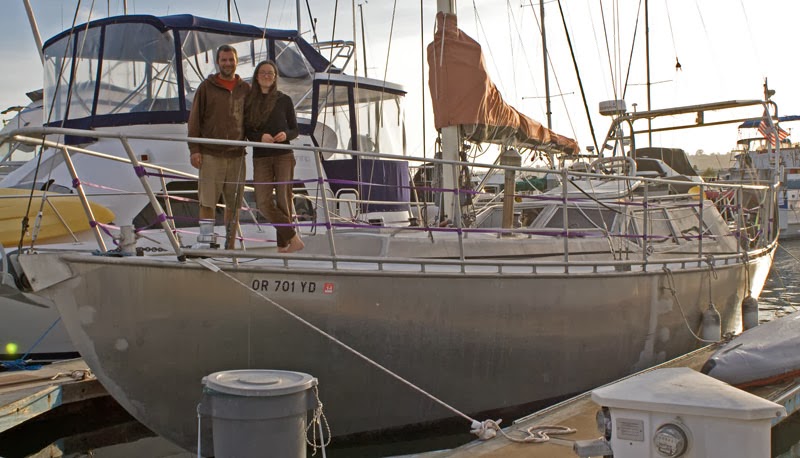
Once turned around, it was a straight forward exercise to get the hell out of there. I motored past the beautiful boat I had spotted and saw another that I was pretty sure was the one Dan meant. It was. Getting into my slip and tied up was easy – once again aided by helpful, concerned boat owners. In the picture to the right, Laelia is the one with the American flag flying high. Just another marina, but also the end of a hard won leg of this adventure.

It took about half an hour to get registered. Dan and Dee (on the right in the photo) invited me to come on over to Rocket Girl when I was ready. I was presented with a welcoming handshake from Dan, a hug from Dee and a cold beer. Daniel and Heather (on the left in the picture) from Stormy Dawn – new acquaintances of Dan and Dee’s – joined us shortly. We laughed, drank more beer and ate Dee’s delicious chili as darkness fell. Shortly after darkness fell, so did I – right into my bunk. It had been a trying day but one that ended well. I was in La Paz at last.

Sunday, March 30, 2014

Not all dreams come true


From the beginning, when I told people I wanted to circumnavigate the reaction was something like “At your age?” My response was something along the line of “I’m in good shape and I have experience doing this.”

I was wrong. The first four days out of Ensenada were enough to show me that. I have given up the idea of circumnavigating. I am going to spend some time in the Sea of Cortez, then head back north to San Diego. I will probably sell the boat there. I think my sailing days are fast coming to an end. Read on for details.

----

The big day finally arrived. Sunday, March 9, I departed San Diego heading for Ensenda. As I was sailing out San Diego Bay, I reached for my phone to call Judy. AT&T had turned it off a day earlier than I wanted – so no phone service. That was when it really hit me. No more 9 PM phone calls. Fifteen to eighteen months of little or no contact. I had, of course, known this all along but somehow the emotional impact was unexpected.
With that sinking realization I watched San Diego disappear over the horizon.
Getting the boat down to Ensenada, through Mexican bureaucracy and back out to sea took my mind off the separation for most of the next three days. The hard part of getting to Ensenada is that it is almost a full day (24 hours) sailing time. Being that close to land and sailing through an area where I had been warned that there were lots of unlit fishing boats operating at night meant that I got very little sleep between San Diego and Ensenada. The sleep that I got was in 20 – 30 minute naps terminated by an obnoxious alarm that I set to make sure I didn’t sleep too long.

I got into Ensenada mid-afternoon on Monday. I checked into Cruiseport Marina and was informed that it was too late to go through the entry paperwork for bringing myself and the boat into Mexico. I wasn’t entirely sorry to hear that. I was so tired that I could hardly make sense of what was going on. I went back to the boat and slept for a solid 18 hours.

Tuesday, my first job was to get Mexican liability insurance for the boat. That entailed a walk of about a mile through the area of Ensenada that is immediately adjacent to the cruise ship dock. As you can see from this picture, the entrepreneurs in Ensenada have figured out what gringos want the most. I saw a number of shops with similar offerings.

I found the insurance office. I speak almost no Spanish and the woman who handled my transaction spoke limited English. It got comical at times, but in the end it all worked out. I walked out $250 poorer but with the needed insurance. When I got back to the marina, one of the marina staff drove me to the building where the entry paperwork was done and walked me through all of it. After all the horror stories I had heard about how complicated it was, it was a relief to make it in and back out in less than an hour.

I had done a lot of shopping for food in San Diego but I did not buy any fruit or vegetables since I had read that they would be confiscated. No one ever asked about fruit or vegetables or anything else I might have on the boat and no one came to the boat to inspect. I had planned to buy the things I thought I couldn’t bring into Mexico when I got to Ensenada but for some reason, I felt the need to get out of there as soon as possible. Partly it was a matter of not wanting to spend another $45 to stay another night. I paid for that dearly over the next days. A diet of canned food gets monotonous very quickly.

Departing Ensenada was no easier than getting in. It involved sailing all night through  Bahia Todos Santos (All Saints Bay), past some islands and (once again) keeping a sharp lookout for fishing boats. To complicate matters, the wind was light and variable. I was busy all night steering and managing sails. By the time I got out onto the open ocean, I was pretty tired again. The good news was that I was getting far enough away from land that I could safely sleep for longer periods of time – up to an hour.

It didn’t take long to discover that Laelia has some very unattractive characteristics sailing in the big swells of the open ocean. One is that when she is going down wind and the seas are coming diagonally from behind, she is very difficult to steer. Her short keel and beamy (wide) hull combine to cause her to yaw (slew from side) wildly. The Monitor windvane could not keep Laelia on a straight course. Her heading varied through a range of 20 t0 30 degrees each side of the desired course. Precise navigation is difficult under those circumstances. Her wide beam also made her lift very quickly as wave passed under her. Keep in mind that the waves were coming from the sides as well as from behind. That meant that one side would lift before the other. She would roll – and roll very quickly. It was a most uncomfortable ride.

I had a problem with my new jib ripping along the leach (trailing edge) of the sail on the leg from San Francisco to San Diego. I sent the jib back to Hood Sailmakers and they repaired it. Neither they nor I had any idea why it ripped. Now, I was seeing the same problem with the main sail. Two panels had rips along the leach seam. There was plenty of wind so I figured that I could get along without the main and sail under mizzen and jib until I got to a place where I could patch the sail. Shortly afterward, the mizzen started showing rips as well.

I contacted Hood via my inReach communicator and after several days of trading emails, they said they had run some tests on the batch of cloth the sails were made from and the cloth was defective. The cloth is not what Hood normally uses. They make their own cloth for normal sails but I asked for tanbark (reddish brown) sails. They bought the cloth from another vendor.

Hood is replacing all three sails – jib, main and mizzen. The interesting part is how to get them to me. Apparently air freight is not as reliable in Mexico – and there are probably some problems with customs as well. I may have to fly back to California to pick them up and bring them back as baggage – at Hood’s expense.

By the fourth night out, I was getting pretty tired. I had to make a sail change after dark with the boat motion being especially lively. The effort was about all I could manage. It was frightening to realize that if something else happened that required physical effort on my part, I might not be able to respond.  I was also feeling very lonely - with no prospect for change on the horizon.

My memories of my previous sailing experience were based on having a 30 year old body and no intimate relationships. Things have changed. I have a 70 year old body and a wife and children I miss very much. The 70 year old body does not have the stamina of the 30 year old.

To add to the misery, the boat motion was especially violent. It felt like a ride on a rubber ducky in a washing machine. Locker doors were flying open. It was hard for me to stay in my bunk even with the lee canvas in place (see the Rock and Roll posting if you don’t know what a lee canvas is.) This all came at the end of a day when I was feeling especially lonely. Single handing a boat is something like solitary confinement. At some point during the night, I decided that this isn’t what I want to do for the next 15 – 18 months of my life.

At first, my response was to turn around and go back to San Diego – immediately. I spent the next four days working my way north against the wind and currents. I saw a lot of the kind of scene in the picture to the right. At times, it felt like Laelia was airborne before she slammed into the next wave. At the end of four days, I was only as far north as Turtle Bay well less than half way back to Ensenada where I would have to check in to do the paperwork for exiting Mexico. The rips in the mizzen were getting larger so I decided to stop at Turtle Bay and see if I could patch them.

Turtle Bay is a nice, quiet little place with a small village on the north side of the bay. It is a secure anchorage with little wave action to rock the boat. After anchoring, I slept – a two hour nap followed by a wine and spaghetti dinner and another 14 hours of sleep.

The next day, I started in on the sail repair. The top picture shows the kind of damage I was trying to repair. I couldn’t really repair the rips. The best I could do was to cover them up with patches that would keep the wind out of the rip and (hopefully) keep the rip from spreading. The bottom picture shows my solution. This involved taking the main and the mizzen off their respective masts, spreading a portion of each sail out flat enough to work on and hand sewing the patch. This took most of two days.


When I announced that I was turning back, a spirited dialogue ensued between Judy and myself leaving me wondering if I had a place to come back to. The dialogue was carried on via my inReach satellite communicator which restricts emails to 160 characters. It is not a format that allows a lot of descriptive detail. We were later to figure out that there was a lot of miscommunication in that dialogue.

Considering all those factors rest, dialogue, sail repair and the problem of getting the replacement sails, I decided to continue on to the Sea of Cortez. I hate to turn back with nothing at all to show for this trip. I had friends (Dan and Dee on Rocket Girl) who had left about a week ahead of me, headed for La Paz. I also decided to try to make life easier for myself by breaking the trip up into shorter legs with rest stops.

The next stop was Bahia Santa Maria, just outside Bahia Magdelena. That was a two day and two night leg. On arrival at Bahia Santa Maria, the patches appeared to be holding up. I got a good night’s rest and continued on toward Cabo San Lucas.

I rounded Cabo San Lucas on the morning of March 28. The difference was immediately noticeable. For the first time in almost three weeks, the air was warm. I could shed my foul weather gear and be comfortable in tee shirt and shorts. A whale watching boat passed close by and I could see the whales they were following.

I elected to bypass the city of Cabo San Lucas on the grounds that it was morning and I didn’t want
to stop yet and the reputation of Cabo as a very touristy, expensive kind of place. I put in to Marina Puerto Los Cabos just outside the city of San Jose del Cabo. To my surprise, it is more expensive to get a slip here than it is in San Diego - $60/day here vs. $45/day in San Diego. It is a nice facility, fairly new, has wifi Internet connectivity and is well kept up, but certainly not fancy. The boats here are mostly sport fishing boats and mega yachts. It is obvious that there is a lot of money around here somewhere.

Once again, I fixed a wine and spaghetti dinner and crashed for a 14 hour nights’ sleep. Yesterday, Saturday, March 29, was mostly devoted to catching up on all the things I haven’t been able to do because of the lack of an Internet connection – pay bills, answer email, catch up on the news.

I had planned to spend only one full day here before moving on but I realized last night that I need another rest day before I push on. I will be on my way north to La Paz starting tomorrow. I will probably make stops at three anchorages along the way with a days’ layover in each before getting to La Paz.

So, that’s the story to date. I don’t know when I will have Internet again – certainly not before La Paz. I am looking forward to continuing at a more relaxed pace. I want to spend a couple weeks recuperating before I turn around and start the trip north. I will be a rough trip – against prevailing winds and currents. It is referred to by sailors as “The Baja Bash.” From what I saw in the days I was trying to go north, it is quite appropriate. But, more on that when the time comes.

Friday, March 7, 2014

Farewell to San Diego


I first came to San Diego from Washington, DC, in late 1974. I was part of a group supporting the installation of new software at the Naval Communication Station at Broadway and Harbor Drive. I came under protest. I had just bought my boat and started living aboard in Annapolis, MD. I was here in San Diego for about four days when I decided I did not want to go back. It all worked out. I got the job as site rep on the installation I was supporting. My company paid to truck the boat here and I lived aboard in San Diego Harbor from about March 1975 until Christmas Day 1975 when I set sail for Hawaii and on to Guam.

I have visited several times since and always felt there was something almost magic about the place. When I sailed into San Diego Harbor two months ago, it was homecoming of sorts. I instantly felt at home. An additional attraction this time was that daughter Alana now lives here. This would give us some time to visit - and as it turns out, we've been able to get together almost weekly for dinner and time to talk. So wonderful after years of living so far apart!

I arrived here with a list of three items to fix up before I left. I expected to be here two weeks and then go on to Mexico. As the previous blog relates, the list quickly grew to 16 items and beyond. I put off my departure for an additional two weeks because of problems with the Mexican government “embargoing” (impounding) boats for minor or imagined paperwork problems. Just before the two weeks was up, my transmission broke again. It was the same problem as I had about a year and a half ago – the damper plate splines were sheared off. In addition the splines on the input shaft to the transmission were ruined. I signed up for another month in my slip and started to work.

One of the unexpected benefits of the additional delay was that I was able to take a trip home to spend time with Judy. I had been worried that five days might be too long - that I would start feeling claustrophobic being in Placerville. It turned out not to be a problem. Our five days together flew by filled with talk, walks, good food, a visit to the restaurant where we had our first meeting - and much more. We also managed to also squeeze in two short visits with daughter Lane. The problems that kept me in San Diego have turned out to be a blessing.

The transmission problem was resolved without too much trouble or expense. Another Pearson 365 owner had a transmission identical to mine that he was willing to sell at an extremely reasonable price. I found a different vendor for the damper plate who had an improved, more robust version. The transmission was in Phoenix where the boat owner lived. Once again, Terry Hoffart came to the rescue. He and his wife, Heather, were planning to come from Phoenix to San Diego for President’s day. He picked up the transmission, paid the owner and brought it over. With his help, I had it installed and ready to run in a little under two hours. We had two enjoyable evenings on the boat and a day sail to try out the transmission. That’s Heather in the picture to the right.

While I was lining up the transmission replacement, I was also studying for the amateur extra class license exam. I took the exam Saturday of President’s Day Weekend. I think I aced it. All the examiner would say was “Well, you did rather well!” My new call letters are AG6YW. I have spent only a little more time tinkering with the installation because of all the other activities. The most recent change was to make the antenna wire as long as possible. I have been able to talk to a couple of stations with it. I think (I hope) that part of the problem is that I am surrounded by sailboats with metal masts and wire rigging that distort the antenna radiation pattern and result in a much reduced signal when I transmit. I will be trying it again when I get out to sea.

I was able to use the extra time to make several improvements. I modified the running pole installation to make it easier to use. I installed an inverter to provide 120 volt AC house current from the boat’s 12 volt DC battery system when I am not hooked up to shore power. I wanted this because I have a number of small items that run off house voltage that I have only been able to use when I am in a slip. The computer printer and the camera battery charger are a couple of them. I have to be careful about using it because it pulls a lot of current from the battery. To do this “all” I had to do was hook up two wires to the battery. But this is a boat and nothing turns out to be that simple. The first problem was to find a way to have a short cable run from the battery to the inverter. That meant pulling out all those bulkheads out the port cockpit locker that I installed a month ago. I had installed them with knowing that I might have to do that, so it was only moderately painful – after I pulled everything out of the locker. Chaos reigned again on deck. But, the job is done. The inverter works.

I have greatly enjoyed the people I have been associated with here in San Diego. Dan and Dee Kent on Rocket Girl hired me to go sailing with them and coach them on sailing their boat. They are experienced power boaters but this is their first sailboat. They didn’t need much coaching. We got to be friends as well and spent several evenings talking, laughing and drinking beer.

My immediate next door neighbors are Jason and Lauren on Perpetua. They bought the bare aluminum hull and spent the next four years getting her outfitted and ready to sail to the South Pacific. They had a rental car and have been quite generous in taking me along on shopping expeditions. We have visited back and forth and exchanged a lot of information and idea for our pending journey. Lauren is a radio amateur as well and we have set up a schedule to keep in touch once we leave here. And, as always seems to happen with boat people, we spent enjoyable evenings talking, eating and drinking.

Carl and Jan Paul on Sequoia scanned documents for me that I needed to have in digital format to send off to French Polynesia. They also gave me their duplicate copy of a cruising guide to the South Pacific and information on where to find charts and courtesy flags in San Diego.
 
What is a courtesy flag, you ask? When a boat is visiting another country, it is a courtesy to fly their flag from the starboard spreader. Often the "courtesy" is a requirement. Showing up without the proper flag flying can result in a fine and/or a requirement to buy a rather expensive flag. I have bought flags for Mexico, French Polynesia (the French Flag), Tonga, Australia and New Zealand. New Zealand is the protector(?) for several island groups in the Pacific. I hope to visit the Cook Island - one of the protectorates, hence the need for the NZ flag.

Greg Lakes on Whisper also gave me a lift several times to track down parts for the boat as well as being another source of ideas and conversation over beer.

I also made contact with Jane Wassel while I was here. Her husband, Stan, was my partner in support the computer installation when I was on Guam 1976/77. They split up after I left and she moved to San Diego. She and Stan reconnected here in San Diego shortly before he died of cancer. It has been fun to catch up on the doings and whereabouts of people I knew on Guam. I got to take her for a day sail so she could see what the boat was all about. She has driven down to the marina several times to go for brisk walks – she sets a mean pace! To top it all off, she drove me on a five hour expedition to do my final shopping for groceries and supplies. It would have taken me a lot longer and a lot of trips to do it by bicycle!

By the way, if any of you are concerned that I might run out of supplies on the 30 day leg to the Marquesas, check the picture to the right! I expect I will be able to get at least to Australia before I have to do any major shopping. I didn’t buy fruits and vegetables on this trip since many of those items would be confiscated when I enter Mexico. I will buy those items in Mexico. Finding places to store all of this has been a challenge!

Now it is time for all of us sailors to move on. Rocket Girl left a week ago and is now anchored just outside Bahia Magdelena on her way to Cabo San Lucas. I hope to catch up with them somewhere in the Sea of Cortez. Perpetua is leaving Sunday to the Marquesas Islands. Sequoia is leaving Saturday or Sunday to go to Mexico.

I have changed my mind again and I will be leaving for Mexico Sunday. The general opinion seems  to be that the Mexican government has been sufficiently embarrassed by the embargo fiasco and will not repeat it soon. The first leg will be an overnight hop to Ensenada where I can do all the paperwork for entry into Mexico with the boat. From there, I will probably go to Bahia Magdelena, stop for several days, then go on to La Paz and on to cruising in the Sea of Cortez. Sometime in early to mid April I will re-provision in La Paz and head for the Marquesas Island.

So – once again I leave San Diego with pleasant memories. The marina facilities are quite good and the management is friendly. The boating community has been wonderful. The weather has been pleasant (mostly). Sunsets are often spectacular enough to make me stop and watch. San Diego is a place that I want to come back to in the future.

For now, the die is cast - time to move on! I called AT&T today and my phone service will terminate Sunday at midnight. From here on, all email will be via wifi. I am set up on Skype in the hope of being able to talk to Judy and other family members.

On to Mexico!